
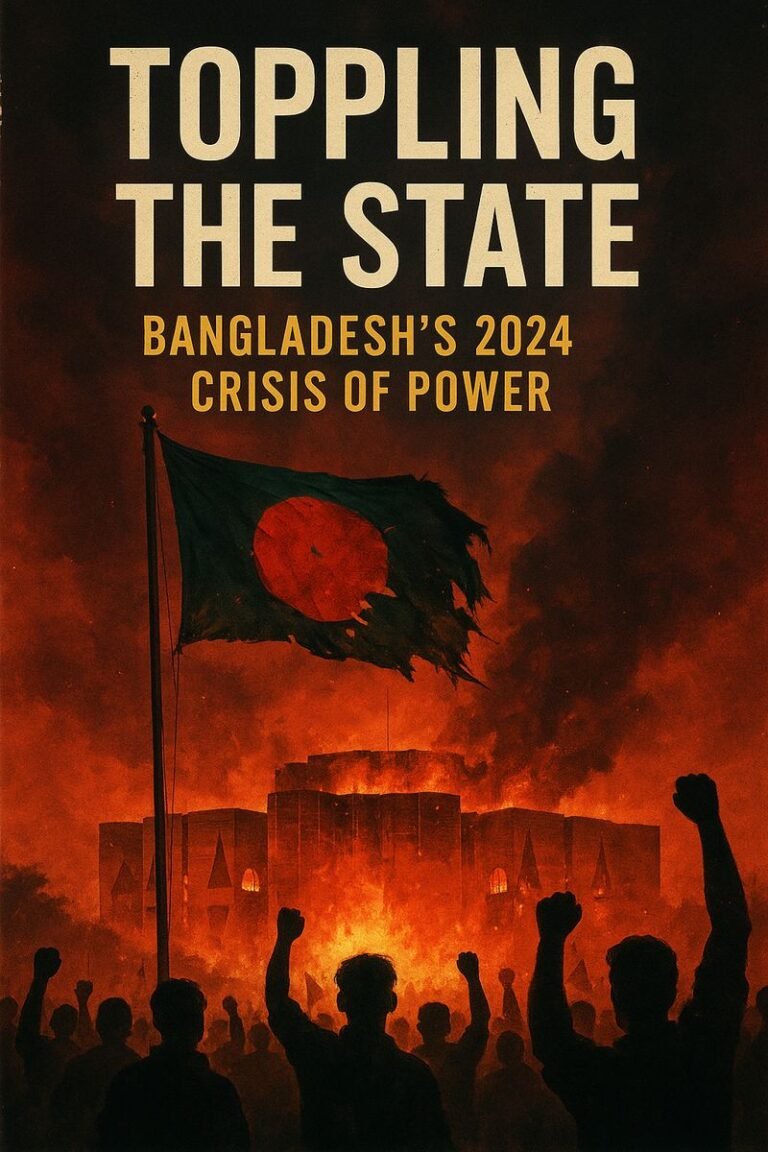
Toppling the State: Bangladesh’s 2024 Crisis of Power
Imran Chowdhury
” COMING SOON ”
To
Those who laid their lives for Bangladesh’s Birth
Chapters
- Bangladesh Before the Storm: The Political Landscape Pre-2024
- July 2024: When Dissent Found Momentum
- Students, Streets, and Symbols: How Protest Narratives Were Shaped
- From Economic Grievance to Regime Challenge
- The NGO–Media–Activist Nexus
- The Mullahs Move In: Faith as Political Capital
- Radical Capture of Popular Discontent
- Silent Signals from the Barracks
- The Doctrine of “Stability”: Military Calculations Explained
- Was This a Coup Without Tanks?
- Anatomy of a Military-Backed Power Shift
- Pakistan’s Long Shadow: Ideology, Intelligence, and Alignment
- Foreign Deep State or Convenient Convergence?
- Intelligence Agencies: Watching, Nudging, or Steering?
- The Judiciary and Bureaucracy: Passive or Complicit?
- Media as Amplifier, Not Arbiter
- Erasing 1971: The Politics of Historical Revisionism
- Minorities, Secularism, and the Shrinking Civic Space
- Interim Power and the Illusion of Neutrality
- Who Benefited from the Fall?
- The Army’s Image vs the Army’s Interests
- Why No Classic Coup? Lessons from 1975–2008
- Bangladesh’s Strategic Re-Orientation
- Democracy Deferred or Democracy Dismantled?
- Which Way Bangladesh Is Heading
Foreword
Toppling the State: Bangladesh’s 2024 Crisis of Power
History rarely announces itself with clarity. More often, it arrives disguised as disorder—through crowds on the streets, slogans shouted with conviction but little coherence, institutions paralysed by indecision, and power changing hands without the formal vocabulary of coups or revolutions. Bangladesh’s 2024 crisis belongs firmly to this category of historical rupture: an event that will be debated, denied, reframed, sanitised, and weaponised for decades to come.
This book is written against that inevitable fog.
Bangladesh has known upheaval before. It was born in blood in 1971, baptised through genocide, war, and an unyielding assertion of linguistic, cultural, and political selfhood. Since then, it has lived through assassinations, coups d’état, counter-coups, military regimes, controlled democracies, electoral engineering, and externally lubricated political settlements. Yet even within this turbulent continuum, 2024 stands apart—not because tanks rolled down Dhaka’s avenues, but precisely because they did not.
What unfolded in Bangladesh in 2024 was not a textbook military coup. Nor was it a spontaneous people’s revolution in the classical sense. It was something more complex, more modern, and arguably more dangerous: a calibrated toppling of the state’s political order through convergence between street mobilisation, ideological radicalisation, institutional paralysis, and strategic silence from the coercive arms of the state.
This foreword sets out the historical, moral, and analytical lens through which this book must be read.
Beyond the Comfort of Simplistic Narratives
In the immediate aftermath of political upheaval, societies instinctively reach for simple explanations. Protest becomes “the people’s will.” Silence becomes “neutrality.” Collapse is rebranded as “transition.” Bangladesh in 2024 was no exception.
One narrative casts the events as a righteous uprising led by students and civil society against authoritarian excess. Another frames it as foreign interference, a shadowy “deep state” operation choreographed from abroad. A third insists it was an Islamist takeover in disguise. Yet another claims the armed forces merely stood aside, honouring democratic restraint.
Each of these narratives contains fragments of truth—and each, on its own, is profoundly insufficient.
This book proceeds from a different premise: that Bangladesh’s 2024 crisis can only be understood as a convergence event. At this moment, multiple actors with divergent motivations found temporary alignment in the removal of an incumbent political order. Not unity of purpose, but coincidence of interest.
Students protested, often genuinely, against economic exclusion and political suffocation. Islamist networks saw an opportunity to reclaim ideological space long denied to them. Foreign actors recalibrated their preferences amid shifting regional geopolitics. And the military—perhaps the most consequential actor of all—chose restraint, not as an apolitical virtue, but as a strategic calculation shaped by history, legitimacy, and self-preservation.
To understand this convergence, one must resist the temptation of moral binaries. This is not a book about heroes and villains. It is a book about power: how it is exercised, deferred, outsourced, and disguised.
The Ghosts of 1971 and the Weight of History
No serious analysis of Bangladesh’s present can be divorced from its past. The state was forged in opposition to military authoritarianism, religious majoritarianism, and external domination. Its founding trauma—genocide perpetrated by the Pakistan Army with the complicity of local collaborators—was not merely a historical event; it was a moral charter.
Yet history in Bangladesh has never been settled. It has been contested, rewritten, weaponised, and selectively forgotten. From 1975 onwards, successive regimes sought to dilute, reinterpret, or monetise the legacy of the Liberation War. Islamist rehabilitation, military ascendancy, and externally influenced political engineering all chipped away at the secular-nationalist foundations of the republic.
By 2024, the erosion had reached a critical point. A generation with no living memory of 1971 was politically active, ideologically unanchored, and economically frustrated. Historical literacy had given way to algorithmic narratives. The language of grievance increasingly replaced the language of liberation.
This matters because revolutions—or events that masquerade as such—do not occur in a vacuum. When the symbolic anchors of a state weaken, the state itself becomes vulnerable to redefinition. What happened in 2024 was not merely the fall of a government; it was an assault—intentional or otherwise—on the ideological scaffolding of the Bangladeshi state.
The Moral Question: Responsibility Without Uniforms
One of the most contentious questions this book confronts is the role of the armed forces. In Bangladesh’s past, military interventions were overt: coups announced on radio, constitutions suspended, generals ruling by decree. 2024 offered no such clarity.
And yet, to conclude that the military was uninvolved is to misunderstand power.
Modern civil–military relations rarely operate through blunt force alone. Silence, delay, selective enforcement, and “constitutionalism” can be as decisive as tanks. The refusal to act can be as political as the decision to intervene.
This book does not argue that the Bangladesh Army seized power in 2024. It argues for something subtler and more troubling: that the military’s strategic non-intervention decisively shaped the outcome. By choosing not to defend the constitutional order under stress, the armed forces became an enabling factor in its collapse.
This raises uncomfortable moral questions. What is the duty of a military in a fragile democracy? To remain neutral between competing political forces? Or to uphold the constitutional order against extra-parliamentary overthrow?
Bangladesh’s history offers no easy answers. The army’s own institutional memory—scarred by 1975, 1981, 1990, and 2006–08—has cultivated a deep aversion to overt rule. But aversion to coups does not equate to commitment to democratic continuity. Between intervention and abdication lies a grey zone where power is exercised invisibly.
It is within this grey zone that 2024 must be analysed.
Foreign Hands and Regional Realignments
No discussion of Bangladesh’s crisis would be complete without acknowledging the international dimension. Bangladesh occupies a strategic crossroads—geographically, economically, and ideologically. It sits between India and Southeast Asia, engages China as an infrastructure partner, balances Western economic interests, and remains entangled—historically and psychologically—with Pakistan.
The question is not whether foreign actors were interested in Bangladesh’s political trajectory; they always are. The question is whether their interests aligned with domestic forces in ways that accelerated or legitimised the state’s toppling.
This book approaches the “foreign deep state” hypothesis with caution—not dismissal, but rigour. It distinguishes between direct orchestration and indirect facilitation, between covert action and strategic opportunism. Influence in the modern era rarely takes the form of regime-change conspiracies alone; it operates through funding flows, narrative amplification, diplomatic signalling, and selective pressure.
Pakistan’s role, in particular, demands sober examination. While no longer the dominant adversary of 1971, Pakistan remains an ideological reference point for certain factions within Bangladesh. The rehabilitation of Islamist narratives, the erosion of Liberation War memory, and the re-normalisation of anti-India rhetoric do not occur in isolation.
Whether by design or drift, Bangladesh’s 2024 crisis opened doors that had long been thought closed.
Analysis, Not Advocacy
This foreword must make one final commitment clear: this book is not written to glorify the fallen, sanctify the triumphant, or provide comfort to any political camp. It is written in the belief that unexamined upheaval breeds future catastrophe.
Bangladesh today stands at a crossroads. The language of “transition” masks a profound uncertainty about the state’s direction. Is the country moving toward a more inclusive democratic order—or toward a softer, more fragmented authoritarianism, infused with religious populism and institutional weakness?
The answer depends on whether Bangladesh can confront the truth of 2024 honestly.
This book offers no slogans. It provides analysis grounded in history, institutional behaviour, and ideological patterns. It challenges convenient myths—about neutrality, spontaneity, and inevitability. And it insists that the toppling of a state, even without gunfire, is never cost-free.
The crisis of power in 2024 persists. It has merely entered its most dangerous phase: normalisation.
This foreword invites the reader to resist that normalisation—and to read what follows not as a settled verdict, but as a necessary reckoning.
Preface
Toppling the State: Bangladesh’s 2024 Crisis of Power
This book was not conceived in the calm detachment of hindsight. It was born amid confusion, noise, competing certainties, and an almost choreographed rush to closure. Within days of the political unravelling of Bangladesh in 2024, narratives hardened. Labels were applied. Moral verdicts were issued. The past was rearranged to suit the present, and the future was spoken of as if it were already secured.
This book is written in resistance to that haste.
Bangladesh’s 2024 crisis was not merely a change of government; it was a moment of structural rupture—a point at which the balance between state authority, ideological forces, institutional restraint, and foreign influence shifted decisively. Such moments demand patience, intellectual honesty, and a willingness to interrogate uncomfortable truths. The purpose of this preface is to make explicit the standpoint from which this book is written, the scope it undertakes, the methodology it employs, and the warnings it issues.
This is not a memoir, though the author’s life has been shaped by the history this book examines. It is not a partisan manifesto, though it will displease partisans on all sides. It is an analytical work, written with the conviction that silence, evasion, and selective amnesia are themselves political acts—and often the most damaging ones.
The Author’s Standpoint: History as Lived Experience, Not Inheritance
No author approaches Bangladesh without baggage. The country’s modern history is too raw, too personal, too unfinished to allow the luxury of abstraction. I write as someone whose life has intersected with Bangladesh’s defining traumas: the Liberation War, displacement, military institutions, post-independence political decay, and the long struggle between secular nationalism and religious mobilisation.
This standpoint matters—not because it grants moral authority, but because it imposes responsibility.
I belong to a generation for whom 1971 is not mythology. It is memory. It is the smell of fear, the geography of refugee camps, the language of loss, and the cost of survival. That inheritance carries obligations: to resist historical falsification, to challenge ideological laundering, and to speak when silence becomes complicity.
Yet this book is not written to sanctify the past. The Liberation War was not a blank cheque for perpetual political entitlement, nor did its ideals inoculate Bangladesh against corruption, authoritarianism, or moral drift. To say so would be to betray the very principles for which the war was fought.
The author’s standpoint is therefore one of critical fidelity: fidelity to the foundational values of the Bangladeshi state—sovereignty, secularism, dignity, democratic aspiration—combined with a willingness to interrogate how those values have been eroded, instrumentalised, or abandoned by successive regimes, including those who claim their mantle.
The events of 2024 are approached not as an aberration but as a culmination. They are the product of long-term structural failures, ideological compromises, and institutional habits that have been decades in the making.
Why This Book, and Why Now
Bangladesh has experienced upheavals before, but 2024 differs in form and consequence. Earlier crises announced themselves through violence and decree. This one unfolded through ambiguity.
There were no proclamations of martial law. No suspension of the constitution—at least not formally. No uniformed generals addressing the nation at dawn. And yet, the outcome was unmistakable: an elected government was displaced through extra-parliamentary pressure, institutional paralysis, and strategic restraint by the state’s coercive apparatus.
To describe this merely as a “popular uprising” is to abdicate analytical responsibility. To describe it solely as a “foreign conspiracy” is to infantilise domestic actors. To deny the role of radical ideological forces is to ignore empirical evidence. And to absolve state institutions—particularly the military—of responsibility is to misunderstand how modern power operates.
This book exists because Bangladesh is at risk of misunderstanding its own history in real time.
Moments like 2024 harden quickly into myth. If not interrogated early, they become foundational lies—taught to students, repeated by commentators, and invoked to justify future excesses. The danger is not only historical distortion, but policy blindness. States that misread their crises tend to repeat them, often in more destructive forms.
This book is an attempt to slow that process down.
Scope: What This Book Does—and Does Not—Do
It is essential to clarify the scope of this work.
This book does not claim to be an exhaustive chronicle of daily events. It is not a journalistic timeline, nor does it attempt to catalogue every protest, speech, or diplomatic communiqué. Its concern is not surface drama, but underlying dynamics.
The scope of the book is fivefold:
- To examine the structural conditions that made the 2024 crisis possible, including political centralisation, economic exclusion, institutional fatigue, and ideological erosion.
- To analyse the convergence of actors—students, Islamist networks, NGOs, media, foreign interests, and state institutions—whose temporary alignment produced regime collapse.
- To interrogate the role of the armed forces, not through accusation, but through institutional behaviour, historical precedent, and strategic logic.
- To situate Bangladesh’s crisis within a regional and global context, examining how geopolitical recalibration, donor politics, and ideological exports shaped the environment.
- To assess future trajectories, not as predictions, but as plausible outcomes rooted in historical patterns.
Equally important is what this book does not do.
It does not declare the 2024 events either wholly legitimate or wholly illegitimate. It does not romanticise street politics, nor does it advocate repression. It does not assume that stability is inherently virtuous, nor that disruption is intrinsically progressive.
Most importantly, it does not offer easy solutions. Bangladesh’s crisis is structural; its remedies cannot be reduced to electoral scheduling or constitutional tinkering.
Methodology: Reading Power Without Illusions
The methodology of this book is deliberately interdisciplinary. Bangladesh’s crisis cannot be understood through a single lens—legal, political, sociological, or strategic. It requires synthesis.
The analytical framework draws on four primary approaches:
1. Historical Continuity and Rupture
Events are situated within longer arcs of Bangladeshi political history, particularly civil–military relations, the rehabilitation of Islamist forces post-1975, and patterns of externally mediated political settlements. 2024 is treated as a rupture that nevertheless bears the fingerprints of the past.
2. Institutional Behaviour Analysis
Rather than focusing on stated intentions, the book examines what institutions did—or did not do—under stress. Silence, delay, selective enforcement, and rhetorical neutrality are analysed as forms of action rather than as absence.
3. Ideological Mapping
The book traces how narratives evolve, migrate, and attach themselves to grievances. It examines how secular dissent can be co-opted by religious populism, and how identity politics fill vacuums left by economic despair.
4. Geopolitical Contextualisation
Bangladesh’s internal crisis is read against shifting regional dynamics involving India, Pakistan, China, and Western actors. The book distinguishes between direct interference and structural influence, avoiding conspiratorial excess while rejecting naïveté.
Sources include public records, media reporting, institutional histories, comparative case studies, and long-term observation. Where evidence is circumstantial, it is presented as such. Where conclusions are inferential, the reasoning is laid bare.
This is not a book of secrets. It is a book of patterns.
On Language, Tone, and Responsibility
The language of this book is deliberately measured. In times of crisis, exaggeration is seductive; restraint is more complicated and more necessary. Accusations are grounded in behaviour, not motive. Assertions are supported by context, not rhetoric.
Yet restraint should not be mistaken for timidity.
This book asks difficult questions of powerful institutions and popular movements alike. It challenges the moral self-image of those who claim neutrality while benefiting from disorder. It interrogates the comfort many find in ambiguity.
Some readers may accuse this book of being too harsh. Others will say it is not harsh enough. That tension is unavoidable—and healthy. If this book leaves all sides satisfied, it will have failed.
Warnings: What Lies Ahead if Lessons Are Ignored
Every political rupture carries forward momentum. The danger is assuming that the direction of that momentum is benign.
Bangladesh faces several risks in the aftermath of 2024:
- Normalisation of extra-parliamentary regime change, eroding constitutionalism without formal abolition.
- Ideological consolidation by religious actors, filling governance vacuums with moral absolutism.
- Institutional hollowing, as bureaucracies learn that survival depends on adaptability, not principle.
- Foreign recalibration, where Bangladesh becomes a site of influence rather than an autonomous actor.
- Historical revisionism, particularly regarding 1971, which would represent a profound moral rupture.
These risks are not hypothetical. They are already visible in discourse, policy drift, and institutional behaviour.
The greatest danger, however, is complacency—the belief that because violence was limited, the damage was minimal. History suggests otherwise. States often decay quietly before they fracture loudly.
This book issues a warning not in the language of alarmism, but of historical precedent. Bangladesh has walked this road before, albeit under different guises. Each time, the cost of denial was higher.
A Final Word to the Reader
This book does not require the reader’s agreement. It asks for engagement.
Read it sceptically. Challenge its conclusions. Compare its arguments against unfolding realities. But do not dismiss its questions lightly. They arise not from ideological opposition, but from a deep concern for the fate of a state whose birth was neither accidental nor cheap.
Bangladesh’s 2024 power crisis is not over. It is evolving. Whether it culminates in renewal or regression depends on how honestly the nation confronts what has already happened.
This preface is an invitation to that confrontation.
Introduction
July 2024: A Rupture in Bangladesh’s State Trajectory
July 2024 will be remembered not as a single day, nor as a single event, but as a moment when Bangladesh’s political gravity shifted. Something fundamental cracked—not loudly, not ceremonially, but decisively. The change did not announce itself with tanks on the streets or generals on television screens. There were no formal declarations of emergency, no suspension of the constitution in bold print. Yet when the dust settled, the state as Bangladesh had known it no longer stood on the same foundations.
This book begins from a simple but unsettling proposition: July 2024 was not a political transition; it was a rupture.
A rupture differs from a crisis. Crises can be managed, absorbed, negotiated, or postponed. Ruptures alter trajectories. They rewire assumptions about authority, legitimacy, and restraint. After a rupture, institutions behave differently, ideologies reposition themselves, and actors recalibrate what is permissible. Bangladesh crossed such a threshold in mid-2024.
To understand why, one must move beyond the language that quickly came to dominate public discourse—“student movement,” “people’s uprising,” “democratic correction,” or its mirror image, “foreign conspiracy.” These labels obscure more than they reveal. July 2024 was not reducible to street protests, nor was it merely the fall of a government. It was the point at which the mechanisms that had sustained the Bangladeshi state since the early 1990s ceased to function as intended.
This introduction explains why.
The Illusion of Stability Before the Fall
In the years preceding 2024, Bangladesh projected an image of controlled stability. Economic growth figures were regularly cited. Infrastructure megaprojects symbolised ambition. Elections occurred on schedule. The machinery of the state appeared intact.
Yet beneath this surface lay a deepening brittleness.
Political power had become increasingly centralised, not merely within the executive but within a narrow governing ecosystem that conflated state, party, and loyalty. Opposition politics was marginalised rather than integrated. Dissent was tolerated selectively, managed administratively, or neutralised through legal and informal means. Over time, the state’s legitimacy shifted away from participatory consent toward performance-based justification: development, order, and continuity.
Such arrangements can endure—but only while institutional discipline holds.
By 2024, that discipline was fraying. Bureaucratic morale was uneven. Judicial credibility was contested. Law enforcement had internalised risk-aversion. Media credibility oscillated between compliance and opportunism. Most significantly, the armed forces—historically the ultimate arbiter in moments of breakdown—had retreated into a posture of studied restraint, shaped by past overreach and international scrutiny.
What remained was a state strong in appearance, but hollowing in confidence.
July 2024: When Protest Became Catalyst
The immediate trigger of the July upheaval was not ideological. It was economic and generational. Students protesting cost structures, access to education, employment prospects, and perceived injustice did not begin as revolutionaries. Their language was pragmatic rather than existential.
But protest movements do not remain static. They evolve—or they are overtaken.
As mobilisation intensified, the vocabulary of grievance expanded. Economic demands blurred into moral indictments. Political slogans replaced policy complaints. The line between protest and regime challenge became increasingly indistinct. This transformation was not accidental. It followed a pattern observed across societies where political participation has narrowed and institutional responsiveness has declined.
Into this space stepped actors with sharper agendas.
Religious networks, long excluded from formal power yet deeply embedded at the grassroots, recognised an opening. So did civil society factions, media influencers, and political intermediaries whose relevance had waned under a centralised system. Each brought their own narratives, grievances, and ambitions. What had begun as student dissent became a contested movement, its symbolic ownership shifting rapidly.
The state, meanwhile, hesitated.
Law enforcement oscillated between restraint and confusion, and political leadership misread the depth of institutional fatigue. Appeals to authority rang hollow in a climate where authority itself had lost consensual grounding. The state did not fall because it was attacked; it fell because it could no longer convincingly defend itself without delegitimising its own foundations.
The Absence That Mattered Most
In Bangladesh’s history, moments of state breakdown have always been accompanied by one decisive factor: the stance of the armed forces. In 1975, 1982, 1990, and 2006–08, the military’s posture—whether interventionist or supervisory—defined outcomes.
July 2024 was different.
The armed forces neither seized power nor openly defended the incumbent order. Instead, they adopted a position of constitutional literalism combined with operational distance. This was widely interpreted, domestically and internationally, as professionalism—a military refusing to be drawn into politics.
Yet this interpretation demands scrutiny.
In moments of acute stress, non-intervention is itself an intervention. By declining to act as guarantor of constitutional continuity, the military allowed other forces—less restrained, less accountable, and more ideologically driven—to shape events. The result was not neutrality, but redistribution of power.
This book does not argue that the military orchestrated the events of 2024. It argues that the military’s silence functioned as a permissive condition, without which the collapse of the political order would have been far less likely.
This distinction matters. It reframes responsibility not as conspiracy, but as institutional choice.
Foreign Interests and the Geometry of Influence
Bangladesh’s rupture did not occur in isolation. The country exists within a dense web of regional and global interests. Its geography makes it indispensable; its demography makes it consequential; its ideological orientation makes it contested.
By 2024, global alignments were shifting. Strategic patience toward long-standing regimes was wearing thin in some quarters. Normative language around democracy and human rights was being selectively reactivated. Aid conditionalities, diplomatic signalling, and media narratives began to converge.
This does not imply orchestration. It implies opportunistic alignment.
Foreign actors did not need to create instability; they merely needed to refrain from discouraging it. Silence, ambiguity, and calibrated pressure proved sufficient. Meanwhile, regional players—particularly Pakistan—watched with interest as long-suppressed ideological currents resurfaced in Bangladesh’s public sphere.
The result was a geopolitical environment in which the collapse of the existing order was not resisted with urgency but received with accommodation.
Why This Was a Rupture, Not a Reset
Many have described July 2024 as a “reset”—a necessary correction to an over-centralised system. This framing is dangerously incomplete.
Resets assume continuity of state logic. Ruptures disrupt it.
After July 2024, several unwritten rules of Bangladeshi politics were broken:
- That governments fall through elections or coups, not sustained street pressure.
- The military ultimately acts as a stabiliser, not a bystander.
- That Islamist forces operate at the margins, not the centre, of national movements.
- That foreign actors prioritise stability over experimentation in Bangladesh.
Once broken, such rules are difficult to restore.
What replaced them was not a new consensus, but a vacuum—filled temporarily by moral rhetoric and transitional arrangements. History suggests that vacuums do not remain neutral for long. They attract the most organised, disciplined, and ideologically committed actors.
The Stakes of Misreading July 2024
This introduction is written with a sense of urgency because misreading July 2024 carries real consequences.
If the events are mythologised as an unqualified democratic victory, future governments will govern under permanent threat of extra-parliamentary overthrow. If they are dismissed as foreign manipulation alone, domestic accountability will be evaded. If the role of radical actors is minimised, ideological capture will proceed unchecked. If institutional abdication is rebranded as neutrality, state capacity will continue to erode.
Bangladesh’s trajectory now hinges on interpretation.
Nations do not fail only through violence. They fail through gradual abandonment of restraint, memory, and institutional courage. July 2024 marked the moment when Bangladesh began negotiating with those abandonments openly.
What This Book Seeks to Do
This book does not seek to close the debate on 2024. It aims to open it properly.
It treats July 2024 not as an endpoint, but as a diagnostic moment—a lens through which more profound structural weaknesses become visible. It examines actors without romanticism, institutions without reverence, and narratives without deference.
Most importantly, it insists that Bangladesh’s future cannot be secured by denying the nature of its rupture.
The chapters that follow will dissect how this rupture occurred, who benefited from it, and what paths now lie ahead. They will not offer comfort. They will provide clarity.
July 2024 was the moment Bangladesh stopped moving along a familiar, if flawed, trajectory—and stepped into uncertainty. Whether that uncertainty yields renewal or regression depends on the country’s willingness to confront what actually happened when the state was toppled without formally collapsing.
This introduction is the first step in that confrontation.
Chapter 1
Bangladesh Before the Storm: The Political Landscape Pre-2024
Bangladesh, before the storm of 2024, was a country living with a dangerous contradiction: outwardly confident, administratively functioning, economically expanding—yet inwardly fatigued, ideologically unsettled, and morally adrift. To understand how the state could be toppled without a formal coup, without martial law, and without tanks on the streets, one must first understand the political landscape that existed before July 2024. That landscape was not one of sudden collapse; it was one of long erosion. The storm did not arrive unexpectedly. It gathered slowly, fed by accumulated grievances, strategic miscalculations, ideological compromises, and a persistent failure to confront forces that had never reconciled themselves with the idea of Bangladesh as born in 1971.
In the years leading up to 2024, political power in Bangladesh had become increasingly concentrated. This centralisation was often justified as necessary for stability, development, and protection against chaos. And in fairness, there was logic to that argument. Bangladesh’s post-1990 experiment with electoral democracy had been turbulent. Governments rose and fell amid street agitation, hartals, military shadows, and externally mediated compromises. The state learned, painfully, that permissiveness could be fatal. Over time, stability became not just a goal, but an obsession.
Yet stability pursued without renewal inevitably hardens into stagnation. Political participation narrowed. Opposition politics was not absorbed into the system; it was marginalised, fragmented, and delegitimised. Elections occurred, but their competitive meaning diminished. Institutions functioned, but increasingly as instruments rather than arbiters. What emerged was not a classic dictatorship, but a managed political order—one that relied on administrative control, development narratives, and historical legitimacy to compensate for declining pluralism.
For many years, this arrangement held. Economic indicators improved. Infrastructure expanded. Bangladesh projected itself internationally as a development success story. But beneath this progress lay unresolved fractures, particularly around history, identity, and power. The foundational narrative of 1971—secular nationalism forged through resistance to Pakistani military genocide—was never fully internalised by all segments of society. Some accepted it pragmatically. Others tolerated it resentfully. A small but persistent minority rejected it outright.
That minority never disappeared. It adapted.
The rehabilitation of anti-liberation forces after 1975 was not an accident of history; it was a strategic choice made by successive regimes seeking legitimacy, alliances, or counterweights. Islamist parties that had opposed independence were gradually reintroduced into political life. War crimes were relativised, postponed, or forgotten. Over decades, this accommodation created a paradox: the Bangladeshi state celebrated 1971 symbolically while allowing its ideological adversaries to rebuild socially, economically, and intellectually.
By the time Bangladesh entered the 2010s, this contradiction had matured. The state invoked the Liberation War as moral capital, but often failed to translate its values—pluralism, dignity, resistance to authoritarianism—into contemporary governance. Meanwhile, those who had once stood on the wrong side of history learned to speak the language of rights, victimhood, and democracy with increasing fluency. The result was a political culture saturated with symbolism but depleted of trust.
This depletion was particularly evident among younger generations. For millions of students and young professionals, 1971 was no longer lived memory. It was curriculum, ceremony, rhetoric. Their political consciousness was shaped less by liberation narratives and more by daily experiences of competition, exclusion, and precocity. Rising education costs, shrinking public-sector opportunities, and a labour market unable to absorb graduates created a simmering frustration. The state spoke of progress; young citizens experienced congestion.
Into this generational dissonance stepped actors who understood that history, if left undefended, becomes negotiable.
Religious networks—some local, some transnational—had spent years building parallel influence structures: madrasas, charities, informal arbitration systems, online platforms. They were patient. They did not seek immediate power. They sought relevance. Relevance arises when the state appears distant, moral language sounds hollow, and grievance demands interpretation.
By 2024, these networks were no longer marginal. They had developed media-savvy spokespeople, cultivated civil society interfaces, and learned how to align selectively with progressive rhetoric when useful. Their relationship with global Islamist currents was rarely explicit, but it was neither accidental nor coincidental. Bangladesh was not immune to the broader radical synergy sweeping parts of the Muslim world, where identity politics, grievance narratives, and selective historical memory combined into a potent mobilising force.
At the same time, Bangladesh’s international relationships were undergoing subtle recalibration. The country’s long-standing friendship with India—rooted in 1971 and sustained by strategic necessity—had always been complex. Gratitude coexisted with suspicion. Cooperation coexisted with resentment. For some political actors, India remained an ally. For others, it was a convenient foil.
What is often left unsaid is that anti-India sentiment in Bangladesh has rarely been organic alone. It has been cultivated, amplified, and occasionally imported. Pakistan, though diminished in direct influence, never relinquished its ideological interest in Bangladesh. The memory of 1971 remained unresolved in Islamabad, and Bangladesh’s secular-nationalist identity remained an affront to the two-nation theory. Over time, this hostility found expression not through overt statecraft, but through softer channels—narratives, religious solidarity, and shared grievance framing.
This did not mean that Bangladesh was being actively destabilised from abroad at all times. It meant something more subtle: that when conditions became favourable, there existed a ready ecosystem—domestic and external—that could exploit them.
The ruling political order underestimated this ecosystem.
Confident in its control over formal institutions, the state paid insufficient attention to the informal ones. It monitored opposition parties but neglected ideological movements. It measured dissent in terms of numbers rather than narratives. It mistook silence for acceptance and compliance for consent.
Nowhere was this miscalculation more consequential than in the state’s relationship with its own coercive institutions.
The armed forces of Bangladesh had evolved significantly since the era of direct military rule. Scarred by coups, counter-coups, and international isolation, the military had embraced a doctrine of professional restraint. Peacekeeping roles abroad, constitutional language at home, and a careful distance from overt politics shaped its self-image. This evolution was real and, in many respects, commendable.
But restraint carries risks when it becomes detachment.
By the early 2020s, the military had retreated from its traditional role as the final guarantor of state continuity. This retreat was influenced by past overreach, fear of international backlash, and a desire to preserve institutional cohesion. Yet it also created an expectation vacuum. Political leaders assumed support that was no longer unconditional. Protesters assumed non-intervention as a right. Ideological actors assumed space.
This shift was not openly discussed. It was implied, sensed, but rarely acknowledged.
Meanwhile, law enforcement and civilian administration absorbed years of politicisation and fatigue. Decision-making slowed. Risk-aversion became standard. The instinct to wait—to see which way the wind would blow—replaced the instinct to uphold principle.
By early 2024, Bangladesh was therefore not a state on the brink of collapse, but a state primed for shock. Its institutions were intact but cautious. Its ideology was celebrated but diluted. Its youth were educated but disenchanted. Its adversaries—both internal and external—were patient, networked, and alert.
The storm, when it came, did not create these conditions. It revealed them.
What makes this pre-2024 landscape particularly troubling is not that mistakes were made—states always err—but that warnings were ignored. Intellectuals who raised concerns about ideological drift were dismissed as alarmists. Critiques of accommodation with anti-liberation forces were labelled divisive. Questions about the long-term cost of narrowing political space were deflected with appeals to stability.
In this environment, even friends of Bangladesh’s liberation—those who had once stood shoulder to shoulder in its darkest hour—began to appear inconvenient. Their advice was interpreted as interference. Their concerns were framed as pressure. Over time, a subtle resentment took root: gratitude faded into irritation, history into burden.
This resentment did not emerge spontaneously. It was nurtured by selective storytelling, by silence about Pakistan’s crimes, by the gradual moral equivalence drawn between perpetrators and victims of 1971. The result was a political culture increasingly comfortable with ambiguity about its own origins.
By mid-2024, Bangladesh stood at a crossroads it did not fully recognise. It believed itself secure because no single threat loomed large. It failed to see that convergence, not conspiracy, posed the greater danger.
When the storm finally broke, many were surprised by its speed. They should not have been.
Bangladesh, before the storm, was a country that had postponed too many reckonings. With history. With ideology. With power. The events of July 2024 did not arrive as an anomaly. They came as a consequence.
Chapter 2
July 2024: When Dissent Found Momentum
July 2024 did not begin with revolution in mind. It started with irritation, fatigue, and a quiet sense of unfairness that had been accumulating for years among Bangladesh’s younger population. What later came to be described—romantically by some, defensively by others—as a historic uprising was, in its earliest days, something far more mundane and therefore far more dangerous: dissent that felt reasonable, relatable, and overdue. That is how momentum begins—not with ideology, but with emotion.
Students were at the centre of this early phase, not because they were uniquely radical, but because they were uniquely exposed. They inhabited the fault line between aspiration and reality. Education had been sold to them as the great equaliser, the ladder out of poverty, the gateway to dignity. Instead, it had become expensive, competitive, and increasingly disconnected from employment. Private university students were burdened with high fees, public university students with session jams and politicised campuses, and graduates across the board with shrinking opportunities. The promise had soured, and by mid-2024, that sourness was ripe.
The initial protests reflected this. Their language was not revolutionary. It was transactional—costs, quotas, access, fairness. There was anger, but it remained anchored in policy. Crucially, there was no immediate rejection of the state itself. The protests were framed as appeals rather than assaults. The students did not yet see themselves as agents of regime change. They saw themselves as claimants to a social contract that felt increasingly one-sided.
This distinction matters because momentum is rarely born radical. It becomes radical when response fails.
The state’s early handling of dissent was hesitant and inconsistent. There was neither meaningful engagement nor decisive containment. Statements were issued, committees promised, but nothing shifted materially. Law enforcement adopted a posture of visible restraint, sometimes commendable, sometimes confused. This restraint was interpreted in contradictory ways. Protesters saw it as moral validation. Opportunists saw it as a weakness. Ideological actors saw it as an opening.
What the state underestimated was how quickly a grievance can mutate once it finds an audience.
Social media accelerated this process. Platforms that once amplified personal frustration now amplify collective outrage. Videos, slogans, and fragments of speeches circulated faster than clarification or context. Complex issues were compressed into binary narratives. The government was no longer slow or unresponsive; it was corrupt, illegitimate, and morally bankrupt. Each allegation fed the next. The threshold for proof dropped. Emotion became evidence.
At this stage, dissent acquired its first layer of momentum: scale.
Crowds grew not because every participant understood the original demands, but because participation itself became symbolic. To be present was to signal virtue, courage, or belonging. Absence, increasingly, was framed as complicity. The moral universe of protest expanded rapidly, leaving little room for nuance.
Into this charged environment stepped actors who had been waiting.
Political forces long marginalised under a centralised system recognised a chance to regain relevance without electoral legitimacy. They did not lead the protests openly; they attached themselves to them rhetorically. Their language was carefully calibrated—democracy, justice, accountability—words broad enough to resonate without committing to specifics. Old rivalries were temporarily suspended. The enemy, for now, was singular.
More troubling was the speed with which religious and anti-liberation elements found oxygen within the movement. They did not announce themselves overtly. They did not lead prayers on the streets in the early days. They embedded themselves in logistics, messaging, and moral framing. Their contribution was subtle but decisive: they reframed dissent from a material grievance into a civilisational one.
The government was no longer accused merely of mismanagement; it was accused of moral deviation. Secularism, once a constitutional principle, was recast as elitism, foreignness, even betrayal. Historical grievances—some real, many manufactured—were woven into present anger. The liberation narrative, always fragile among younger generations, was questioned not directly, but through insinuation. Why was 1971 constantly invoked, some asked, when today’s suffering felt unrelated? Who benefited from that history now?
These questions did not arise spontaneously. They were cultivated.
This is where layers of doubt must be acknowledged. Not every protester was anti-liberation. Not every critic was pro-Pakistan. But it would be intellectually dishonest to deny that forces hostile to the very idea of Bangladesh as a secular nation born in 1971 recognised July 2024 as an opportunity. Their fingerprints were not always visible, but their instincts were familiar. They had learned, over decades, that history can be undone more effectively through erosion than confrontation.
Pakistan’s role in this phase was neither overt nor necessary. The ideological ecosystem that Pakistan had nurtured since 1971—through narratives of religious unity, grievance against India, and revisionist history—already existed within Bangladesh. July 2024 did not require activation from Islamabad; it required permission in Dhaka. When liberation history becomes negotiable, its adversaries no longer need to argue loudly. They only need to wait.
As protests expanded, the state’s response grew more defensive and less strategic. Officials oscillated between denial and moralising. Protesters were alternately dismissed as misguided and condemned as destabilising. This inconsistency fed resentment. Each misstep was magnified online, stripped of context, and repackaged as proof of contempt.
Meanwhile, the silence of key institutions became increasingly conspicuous.
The armed forces remained publicly neutral, reiterating their commitment to constitutional processes. International observers applauded this restraint. Domestically, interpretations diverged. To protesters, the absence of military intervention signalled tacit approval or at least indifference. To radical actors, it confirmed that no red line would be enforced. To the political establishment, it introduced an unease that was rarely spoken aloud.
This silence did not cause momentum, but it legitimised it.
Momentum entered its second phase when dissent ceased to ask permission. Protesters no longer sought dialogue; they demanded outcomes. The language shifted from “reform” to “resign.” The moral framing hardened. Any defence of the incumbent order was treated as an apology. Any call for patience was labelled betrayal.
At this point, dissent crossed a critical threshold: it became performative.
Protest was no longer about achieving specific goals; it was about sustaining pressure. Escalation became its own logic. Each day required a stronger gesture than the last. Symbolism replaced strategy. Emotion replaced organisation. This made the movement powerful—but also vulnerable to capture.
Radical elements exploited this vulnerability expertly. They introduced slogans that sounded inclusive but carried ideological weight. They reframed secular grievances in religious language without explicit dogma. They injected anti-India sentiment into otherwise domestic complaints, subtly recasting Bangladesh’s problems as the product of external allegiance rather than internal failure.
The most insidious aspect of this phase was the recasting of liberation-era friendships. India, once acknowledged—however uneasily—as a friend of Bangladesh’s birth, became a convenient villain. Historical complexity was flattened. Gratitude was replaced with suspicion. The past was judged through present resentment. This was not accidental. Anti-India sentiment has always been the gateway through which pro-Pakistan and Islamist narratives re-enter Bangladeshi politics.
Again, doubt must be layered carefully. Not all criticism of India is illegitimate. Not all geopolitical recalibration is betrayal. But July 2024 saw a familiar pattern: when internal legitimacy falters, external scapegoats multiply. And when liberation history weakens, its enemies speak more freely.
The state, by now, was reacting rather than shaping. Each concession was interpreted as a weakness. Each attempt at enforcement was portrayed as repression. The administrative machinery slowed under pressure, unsure of which actions would trigger escalation. This paralysis fed a sense of inevitability. The idea began to circulate—first in whispers, then openly—that the government’s fall was only a matter of time.
Inevitability is a powerful accelerant.
Once people believe an outcome is inevitable, they begin to act as if it has already occurred. Bureaucrats hedge. Media recalibrates. Allies distance themselves. Even supporters begin to question their loyalty. Momentum, at this stage, becomes self-sustaining.
International actors observed closely. Statements grew cautious. Emphasis shifted toward restraint, dialogue, and human rights. None of this was unreasonable on its own. Collectively, however, it signalled that stability was no longer the overriding priority. The possibility of change—any change—was being entertained.
Foreign pressure did not create the momentum, nor did it arrest it. In moments like July 2024, what matters is not intervention, but signalling. And the signals were, at best, ambiguous.
By the end of July, dissent had fully detached from its origins. What began as a protest against cost and access had transformed into a moral challenge to the state itself. The question was no longer whether reforms would be granted, but whether the existing order deserved to survive.
This is the moment when Bangladesh crossed from crisis into rupture.
The tragedy of July 2024 lies not in the existence of dissent—dissent is the lifeblood of any society—but in how that dissent found momentum without guardrails. Legitimate grievances were allowed to merge with illegitimate agendas. Historical memory was treated as optional. Institutional restraint was mistaken for neutrality. A generation was implicitly and explicitly encouraged to believe that destruction precedes construction.
Those who cheered loudest in July often did not ask what would come after August.
Momentum, once unleashed, does not discriminate between intentions. It carries everyone forward—students and radicals, idealists and opportunists, patriots and revisionists alike. Bangladesh in July 2024 learned this lesson too late.
What followed would expose who had truly been prepared for power, and who had merely prepared for protest.
Chapter 3
Students, Streets, and Symbols: How Protest Narratives Were Shaped
Students did not invent the narratives that dominated the streets in July 2024, but they became their most visible carriers. This distinction is essential. Protest movements often borrow the moral authority of youth while being steered by older, more seasoned actors who understand power, symbolism, and timing far better than those chanting slogans. Bangladesh’s July uprising followed this familiar pattern, though with a sophistication that many observers underestimated at the time.
At first glance, the streets appeared to be student-owned. Placards were handwritten. Chants were youthful, sometimes clumsy, sometimes poetic. Social media feeds overflowed with images of young men and women standing shoulder to shoulder, phones held high, faces animated with conviction. In interviews with local and international media, students spoke in earnest about fairness, dignity, and a desire to be heard. “We are not against the country,” one student from a private university told a television channel. “We are against injustice.” Another, from a public university, insisted, “This is not politics. This is about our future.”
Such statements were genuine. They reflected real frustration and a sincere belief that the streets were the only remaining forum for expression. But sincerity does not immunise a movement against manipulation. On the contrary, it makes it more susceptible.
What unfolded over the course of July was not merely the growth of a protest, but the shaping of a narrative architecture—one that determined what the protests meant, who they represented, and what outcomes were considered legitimate. This architecture did not emerge organically. It was curated, nudged, and, at critical moments, hijacked.
In the early days, protest narratives were narrow and specific. They revolved around economic pressures, education costs, employment bottlenecks, and perceptions of administrative arrogance. Students spoke of feeling invisible in policymaking. “They don’t listen unless we shout,” a female student remarked during a roadside interview. Another added, “Every door is closed. So we came to the streets.”
These comments mattered because they grounded dissent in lived experience. They made it relatable and difficult to dismiss. The state’s failure was not that it disagreed with these grievances, but that it failed to engage them meaningfully before others reframed them.
As crowds grew, the language of protest expanded. Slogans became more abstract, more moral, and more accusatory. Terms such as “justice,” “freedom,” and “people’s power” replaced references to fees or quotas. This shift was subtle at first, almost imperceptible. Many students welcomed it. Abstraction gave their movement dignity. It connected them to global protest traditions. It made them feel part of something historic.
But abstraction also dilutes ownership.
Once slogans lose specificity, they become containers into which others can pour their agendas. By mid-July, it was no longer clear whose voice dominated the streets. Student leaders appeared on makeshift stages, but behind them stood individuals who were not students at all—organisers, logisticians, “advisers,” and self-appointed strategists. They were rarely visible on camera, but they were present in WhatsApp groups, Telegram channels, and late-night planning sessions.
Some students began to notice the shift. “There are people giving instructions who are not from our campuses,” one protester told a journalist off record. Another remarked on social media, “Why are we shouting slogans that we never discussed?”
These observations were often dismissed as paranoia or fear-mongering. In the emotional intensity of the moment, raising questions about infiltration was seen as weakening unity. Yet history suggests that unity without scrutiny is precisely what infiltrators rely on.
The infiltration did not take the form of an overt takeover. There were no declarations, no visible coups within the movement. Instead, it followed a model perfected elsewhere: embed, amplify, redirect.
A small group of pseudo-protagonists emerged—individuals who spoke the language of students fluently, invoked the rhetoric of democracy convincingly, and positioned themselves as protectors of the movement. They offered advice on dealing with police, on managing media attention, on sustaining pressure. They framed themselves as experienced allies, often hinting at past struggles, past injustices, past betrayals by the incumbent order.
Some of these figures had long-standing grievances against the state. Old scores, unresolved exclusions, and ideological defeats from earlier decades resurfaced under the banner of youth protest. July 2024 offered them something rare: moral cover.
Financing followed quietly. Protest movements require logistics—transport, banners, food, communication tools, and legal assistance. In the early phase, students funded these themselves. Contributions were small, personal, and transparent. As the movement expanded, however, resources multiplied. Professionally printed materials appeared. Transport to and from protest sites became organised. Volunteers distributed supplies with efficiency that suggested planning beyond spontaneous solidarity.
Questions were asked, again quietly. “Who is paying for this?” a student leader reportedly asked during an internal discussion. The answer was rarely clear. Funds arrived through intermediaries, sympathetic organisations, and anonymous donors. Each contribution was framed as support for a righteous cause. To question it was to appear ungrateful—or worse, suspicious.
Foreign-linked NGOs and advocacy networks also entered the periphery. Some offered media training, others legal advice, others platforms to amplify voices internationally. None of this was illegal. Much of it was even well-intentioned. But influence rarely announces itself as control. It enters as assistance.
Alongside funding came narrative reinforcement. International media began to frame the protests within familiar templates: youth versus autocracy, democracy versus repression. These frames resonated globally, but they flattened local complexity. They erased historical context. They reduced Bangladesh’s political struggle to a morality play with predefined roles.
Students repeated these frames because they were rewarded for doing so. International attention validated their cause. Social media algorithms amplified content that fit global expectations. A feedback loop emerged: the more the protests aligned with external narratives, the more visibility they received.
Meanwhile, alternative interpretations—particularly those warning of ideological hijacking—were sidelined. Anyone invoking 1971, secularism, or the dangers of religious mobilisation was accused of deflection. “Stop living in the past,” one student posted online. “This is about now.”
This rejection of history was not accidental. It served a purpose.
Anti-liberation elements, long constrained by the moral weight of 1971, found in July 2024 a rare opportunity to relativise that history without directly confronting it. They did not deny the war. They questioned its relevance. They did not praise Pakistan. They attacked India. They did not call for theocracy. They spoke of moral values and cultural authenticity.
In the streets, symbols changed subtly. National flags remained, but liberation slogans faded. New chants emerged, ambiguous enough to mean different things to different ears. Religious references appeared—not dominant, but present. For many students, these were harmless expressions of identity. For seasoned observers, they signalled a shift in ideological gravity.
Again, doubt must be layered carefully. Not every religious reference indicated radical intent. Not every critic of India was pro-Pakistan. But movements are defined not by intentions alone, but by trajectories. And the trajectory was unmistakable: away from the liberation narrative, toward something less defined, more malleable, and therefore more dangerous.
The role of foreign hands in this phase remains contested, and deliberately so. There is little evidence of direct orchestration in the crude sense. No single foreign power can be credibly accused of pulling every string. But influence does not require omnipotence. It requires alignment.
Global radical currents—particularly those blending anti-Western, anti-India, and religious grievance narratives—found receptive soil in Bangladesh’s July protests. Online content circulated rapidly, linking local dissent to global struggles. Hashtags connected Dhaka to Cairo, Istanbul, even Gaza. The message was subtle but persistent: Bangladesh’s struggle was part of a larger moral battle.
This framing flattered protesters. It elevated their cause. It also redefined their enemy.
By the latter half of July, the incumbent government was no longer criticised merely for domestic failures. It was accused of being an agent of foreign powers, of secular elites, of interests hostile to “the people.” This language was particularly effective because it fused populism with paranoia. It allowed disparate grievances to converge on a single target.
The students, many of whom had entered the movement seeking reform, found themselves at the centre of a symbolic war they had not designed. Some embraced this escalation, convinced that only total rupture could bring change. Others hesitated, sensing that the movement was slipping beyond their control.
Their hesitation came too late.
Momentum rewards certainty, not caution. The loudest voices shaped the narrative. The most radical slogans travelled furthest. Moderation was drowned out by urgency. The pseudo-protagonists, now fully embedded, guided escalation with precision. They knew when to provoke, when to pause, and when to internationalise incidents.
The state, watching this transformation, misread it repeatedly. It continued to see the protests as primarily student-driven, failing to grasp the layered infiltration at work. Its responses targeted visible actors rather than invisible architects. Each miscalculation reinforced the narrative of incompetence and illegitimacy.
By the time officials realised that the streets were no longer speaking in a single student voice, the symbols had already been claimed. The movement had acquired a life independent of its origins.
What July 2024 revealed, above all, was how symbols travel faster than substance. Students carried banners. Others carried agendas. The two were not always aligned.
History will likely remember the students as the face of the movement. That is both understandable and tragic. They bore the risks. They faced the police. They absorbed the consequences. But faces are not the same as hands, and voices are not the same as authorship.
The shaping of protest narratives in July 2024 was not an accident of chaos. It was a process—incremental, strategic, and deeply political. It exploited genuine grievances, borrowed youthful legitimacy, leveraged foreign attention, and reignited old hostilities under new guises.
Those who ignited the flame did not necessarily intend to control the fire. But others did. And they were far better prepared.
Chapter 4
From Economic Grievance to Regime Challenge
The transformation of Bangladesh’s July 2024 unrest from economic grievance to regime challenge was neither instantaneous nor accidental. It was a process—layered, cumulative, and accelerated by miscalculation on one side and opportunism on the other. What began as a dispute over affordability, access, and fairness evolved into a confrontation with state authority itself. This evolution marked the point of no return. Once crossed, the question ceased to be whether demands would be met, and became whether the incumbent order retained the moral right to govern.
At the outset, the economic character of the protests was unmistakable. Students spoke the language of costs, debt, and exclusion. Tuition fees, inflationary pressure on families, graduate unemployment, and perceived inequality in opportunity dominated early discourse. In interviews captured by international agencies, Bangladeshi students described feeling “priced out of the future” and “trapped between degrees and desperation.” One Reuters dispatch in early July noted that students were protesting “the rising cost of education and shrinking employment prospects in a country where youth unemployment remains stubbornly high.” The framing was precise: this was a socioeconomic dispute within the system.
Foreign media initially echoed this interpretation. The Associated Press described the demonstrations as “student-led protests demanding economic relief and greater transparency in governance.” At the same time, the BBC characterised them as “an expression of generational frustration in a fast-growing but uneven economy.” These descriptions mattered. They legitimised the protests internationally as rational, policy-driven dissent rather than destabilising agitation.
Yet even at this early stage, cracks were visible. Economic grievances, while real, were insufficient to sustain mass mobilisation indefinitely. Bread-and-butter issues can ignite protest, but they rarely topple regimes unless they are reframed as symptoms of deeper illegitimacy. That reframing began subtly.
As July progressed, economic language gave way to moral language. Tuition fees became evidence of corruption. Unemployment became proof of systemic injustice. Inflation was no longer a macroeconomic challenge but a moral failure of leadership. Protesters no longer asked for reform; they demanded accountability. Accountability, in turn, was quickly redefined as removal.
This transition was not spontaneous. It was encouraged, amplified, and validated through narrative escalation.
Foreign commentary played a dual role. While early coverage focused on economic roots, later reporting increasingly adopted a political lens. The Financial Times observed that “what began as student protests over economic pressures has widened into a broader challenge to the political order,” noting that demonstrators were now calling into question “the legitimacy of a system seen as unresponsive and entrenched.” The New York Times, in a mid-July analysis piece, wrote that the protests “have morphed into a referendum on governance itself,” adding that “economic frustration has merged with political anger.”
These shifts in language were not neutral. They signalled to domestic actors that the international gaze had recalibrated. What was once a dispute to be managed was now a confrontation to be resolved.
Inside Bangladesh, this recalibration emboldened those who had long sought regime change but lacked widespread traction. Opposition figures, sidelined for years, began to speak more boldly. Civil society actors expanded their critique beyond policy into legitimacy. Protest slogans reflected this shift. References to fees and jobs dwindled; chants demanding resignation grew louder.
The state, meanwhile, struggled to respond coherently. Economic concessions, when offered, were dismissed as too little, too late. Dialogue was demanded, but on terms that implied surrender rather than negotiation—each attempt by the government to reframe the protests as economic was interpreted as evasion.
At this juncture, a critical psychological threshold was crossed: the belief that the government could be forced out through sustained pressure.
Belief is a force multiplier. Once protesters began to believe that regime change was achievable, escalation became rational. Risk tolerance increased. Compromise lost appeal. Moderation was recast as betrayal.
International media coverage reinforced this belief, sometimes inadvertently. Al Jazeera described the demonstrations as “the most serious challenge to the Bangladeshi government in over a decade,” while The Guardian referred to them as “a swelling movement that threatens to upend the political status quo.” Such language, though analytically defensible, carried performative weight. It transformed perception into momentum.
This was also the stage at which foreign political discourse began to intersect more openly with domestic dissent. Statements from Western officials emphasising “the right to peaceful protest” and “the importance of accountability” were welcomed by protesters as moral endorsement. The absence of equally strong statements emphasising constitutional continuity or electoral processes was noted—quietly, but keenly.
The regime challenge narrative gained further traction through selective comparison. Commentators likened Bangladesh to other countries where student protests had precipitated political change. Parallels were drawn, sometimes carelessly, with movements in Sri Lanka, Tunisia, and even parts of Eastern Europe. Each comparison flattened context, but all served the same function: to normalise the idea that economic protest naturally culminates in regime collapse.
What these comparisons obscured was Bangladesh’s unique historical burden. Unlike many states, Bangladesh’s political legitimacy is inseparable from its history of liberation. Any challenge to the regime, therefore, risked becoming, intentionally or not, a challenge to the ideological foundations of the state itself.
This is where anti-liberation and pro-Pakistan undercurrents found renewed relevance.
As economic grievances morphed into regime challenge, liberation-era narratives were increasingly portrayed as obstacles rather than anchors. Protesters and commentators questioned why 1971 continued to dominate political discourse when present suffering seemed unrelated. A columnist in an international outlet wrote that “Bangladesh’s ruling elite has long leaned on liberation credentials that resonate less with a generation struggling to make ends meet.” The observation was not false, but it was incomplete.
Such framing created space for deeper revisionism. If liberation history were merely political capital, then its moral authority could be discounted. If it were discounted, then its enemies could re-enter discourse unchallenged.
This process did not require explicit praise of Pakistan. It required only the erosion of Bangladesh’s moral clarity about its own origins. Anti-India sentiment became a convenient proxy. Foreign media noted the rise of nationalist rhetoric, accusing the government of being “too close to Delhi.” A Reuters analysis observed that “critics have increasingly framed the government as beholden to foreign interests, particularly India, a narrative that resonates among nationalist and Islamist groups.”
Here, economic grievance fused with geopolitical suspicion. Inflation was attributed not only to policy but also to alignment. Scarcity was recast as subservience. Regime challenge acquired a nationalist veneer.
Meanwhile, covert facilitation continued. Funding, logistics, and media access became more accessible as the protests assumed a regime-change character. International NGOs that might have hesitated to support narrow economic protests found moral comfort in backing a “democracy movement.” Again, intent varied. The effect did not.
By late July, foreign newspapers were no longer asking whether the government could contain the protests. They were asking how it would survive them. This shift in questioning mattered enormously. It shaped investor sentiment, diplomatic posture, and domestic confidence. Bureaucrats read these reports too. So did generals.
The government’s authority, already strained, began to fracture psychologically. Ministers spoke defensively. Supporters fell silent. Even within the ruling establishment, doubts surfaced about the sustainability of the status quo.
Economic grievance had done its work. It had opened the door. Regime challenge walked through it.
What makes this transformation especially consequential is that it was never openly debated. There was no collective decision to move from reform to removal. It happened through drift, escalation, and external validation. By the time the language of regime change dominated the streets, the movement had travelled too far to turn back.
Foreign media, reflecting later on the events, would describe July 2024 as a “turning point.” One editorial in The Economist noted that “Bangladesh’s unrest crossed a decisive line when economic discontent was recast as a crisis of legitimacy.” That line, once crossed, redefined everything that followed.
The tragedy is not that economic grievances existed. They were real and deserved redress. The tragedy is that they were allowed—indeed encouraged—to become instruments of total political rupture without a credible plan for what would replace the order they dismantled.
From that moment onward, Bangladesh was no longer negotiating policy. It was negotiating power. And power, once unmoored from constitutional process, rarely returns willingly.
This chapter ends where certainty ends. Whether the transformation from economic grievance to regime challenge was inevitable remains debatable. That it was exploited is not. The events of July 2024 demonstrate how easily legitimate suffering can be repurposed into existential confrontation—and how difficult it is, once that transformation occurs, to contain the consequences.
What followed was not merely the fall of a government, but the opening of a question Bangladesh had long postponed: who, ultimately, has the authority to decide when a regime’s time is up?
Chapter – 5
The NGO–Media–Activist Nexus
The events of July 2024 did not unfold in an informational vacuum. Long before the streets filled and slogans hardened, a dense ecosystem of NGOs, media platforms, advocacy networks, and professional activists had already been shaping the language through which dissent would later be understood. This ecosystem did not create public anger; instead, it framed, curated, legitimised, and ultimately internationalised it. In doing so, it played a decisive role in converting a domestic crisis into a globalised moral narrative—one that both constrained and destabilised the Bangladeshi state.
Before 2024, Bangladesh had developed one of the most extensive NGO sectors in the Global South. Many of these organisations performed vital work in health, education, disaster relief, and poverty alleviation. Their contribution to social development is not in dispute. What is more contentious —and far less openly discussed —is how a subset of this sector gradually migrated from service delivery to political mediation—often without a democratic mandate, institutional accountability, or public scrutiny.
By the late 2010s, several NGOs had repositioned themselves as guardians of “democratic norms,” “civic space,” and “human rights,” adopting the language and frameworks favoured by Western donor institutions. This shift was not inherently illegitimate. However, it altered incentives. Funding became tied not merely to outcomes on the ground, but to narrative alignment—how convincingly Bangladesh could be portrayed as a site of democratic backsliding, civic repression, or authoritarian drift.
This narrative positioning mattered profoundly in 2024.
As protests erupted, NGO-linked advocacy groups moved swiftly—not to mediate between state and protesters, but to frame the unrest internationally. Statements were drafted, reports compiled, press briefings organised. Within days, language hardened. Protests were no longer described as policy disputes; they were framed as resistance to repression. The state was no longer flawed; it was authoritarian. Law enforcement actions, even restrained ones, were catalogued as abuse. Silence by institutions was interpreted selectively, depending on whose silence it was.
International media relied heavily on these NGO briefings. Correspondents unfamiliar with Bangladesh’s layered political history found ready-made analysis, quotable experts, and moral clarity. As one senior foreign journalist privately admitted after the events, “Without local fixers and NGO reports, it’s impossible to read Bangladesh quickly.” Speed, however, came at the cost of depth.
The media–NGO symbiosis intensified. Reports by international rights organisations were cited verbatim by newspapers. Newspapers, in turn, were cited by activists as independent validation. A feedback loop formed in which repetition became credibility. Alternative interpretations—particularly those invoking ideological infiltration, historical revisionism, or Islamist opportunism—were marginalised as government propaganda.
What became increasingly visible after July was how coordinated this ecosystem had been.
In the weeks following the regime’s collapse, fragments of information surfaced—some through investigative journalism, others through leaks, some through inadvertent disclosures. Training workshops conducted months earlier by foreign-funded NGOs were re-examined. Their curricula, ostensibly about “peaceful protest,” “digital security,” and “civic mobilisation,” bore a striking resemblance to tactics employed during July: decentralised leadership, rapid escalation cycles, media-first engagement, and internationalisation of grievances.
None of this proved orchestration. But it did demonstrate preparedness.
Financial trails, though challenging to trace conclusively, raised further questions. Several protest-support initiatives were revealed to have received emergency funding approvals from international donors in unusually short timeframes. Legal aid funds expanded overnight. Media monitoring units scaled up instantly. The efficiency suggested pre-existing contingency planning rather than spontaneous reaction.
Activist networks played a critical bridging role. These were individuals who moved seamlessly between NGOs, media commentary, and protest coordination. They appeared on television as neutral analysts, posted on social media as concerned citizens, and advised protesters behind the scenes. Their ideological positions were rarely disclosed. Their past affiliations—some with movements hostile to the liberation narrative—were often overlooked or deliberately obscured.
It is here that the line between advocacy and antagonism blurred.
Some of these activists carried long-standing grievances against the incumbent regime. Others had been marginalised professionally or politically over the years. July 2024 offered them redemption, relevance, and revenge—often simultaneously. Settling old scores became easier when framed as a moral struggle.
Foreign funding did not create these motivations, but it amplified them. International donors, eager to support “democratic movements,” rarely interrogated the ideological composition of the networks they empowered. In the abstract language of rights and freedoms, historical context was flattened. Bangladesh’s unique genesis—its war against a religious-military state backed by global indifference—was rarely factored into contemporary assessments.
This omission was not accidental. It was inconvenient.
A state born through resistance to Pakistan’s Islamist-military ideology sits uneasily within global frameworks that prioritise procedural democracy over historical trauma. In such frameworks, stability can appear suspect, secularism can seem elitist, and nationalism can be misread as authoritarianism. July 2024 was filtered through these lenses.
Media coverage reflected this bias. Headlines spoke of “crackdowns,” “regime insecurity,” and “people’s movements.” Rarely did they interrogate who defined “the people,” or whose voices were absent from the narrative. Rural perspectives were underrepresented. Minority fears were sidelined. The anxieties of those who saw echoes of 1975, not 1990, were dismissed as paranoia.
After the events, some of these omissions became harder to ignore.
Reports emerged of NGO personnel attending closed-door briefings with foreign diplomats during the height of the unrest. While such meetings are not unusual, their timing raised questions about influence and coordination. Diplomatic cables, later paraphrased by investigative outlets, suggested that embassy assessments relied heavily on NGO and activist inputs rather than state institutions or independent verification.
This reliance shaped foreign responses. Statements emphasised restraint and dialogue, but conspicuously avoided affirming the legitimacy of the incumbent government. The absence was noted domestically. It fed the perception that the state had lost international backing—a perception that further weakened internal resolve.
Meanwhile, covert intelligence assessments—never officially acknowledged but widely circulated among policy circles—pointed to ideological convergence between domestic Islamist actors and transnational advocacy narratives. This convergence was not operational, but discursive. Both framed the state as morally illegitimate. Both dismissed liberation-era secularism as outdated. Both found common cause in anti-India rhetoric.
The NGO–media–activist nexus did not invent these narratives, but it normalised them.
What emerged after July was a clearer picture of asymmetry. The state, bound by formal protocols and institutional caution, communicated slowly and defensively. The nexus communicated rapidly, emotively, and globally. In modern political conflict, speed often defeats legitimacy.
Critics of this analysis argue that focusing on NGOs and media distracts from the state’s own failures. This is a false dichotomy. Acknowledging manipulation does not absolve misgovernance. But ignoring manipulation guarantees repetition.
The most troubling aftermath revelation was the lack of accountability that followed. No comprehensive audit of foreign-funded advocacy during the crisis was conducted. No transparent review of media sourcing practices was undertaken. No parliamentary inquiry examined the role of civil society actors in shaping regime change. Silence prevailed—partly out of fear, partly out of exhaustion, partly out of complicity.
The NGO–media–activist nexus emerged from July 2024 not weakened, but validated. Its narrative had prevailed. Its methods had succeeded. Its moral authority had mainly gone unchallenged.
This validation carries long-term consequences.
When unelected networks acquire the power to delegitimise governments without accountability, democratic fragility increases. When foreign-funded advocacy shapes domestic political outcomes without scrutiny, sovereignty erodes quietly. When the media uncritically adopts activist frames, public discourse polarises beyond repair.
Bangladesh’s experience in 2024 is not unique. Similar patterns have played out elsewhere. What makes Bangladesh’s case distinct is its unresolved historical vulnerability. A state still fighting to preserve the meaning of its birth cannot afford to be captured by narrative.
The NGO–media–activist nexus did not topple the state alone. But it provided the language, legitimacy, and international cover through which others could. That role deserves scrutiny—not to demonise civil society, but to reclaim it from those who mistake influence for virtue.
If July 2024 taught Bangladesh anything, it is this: in the modern age, power often flows not from ballots or barracks, but from those who control the story.
TO BE CONTINUED