
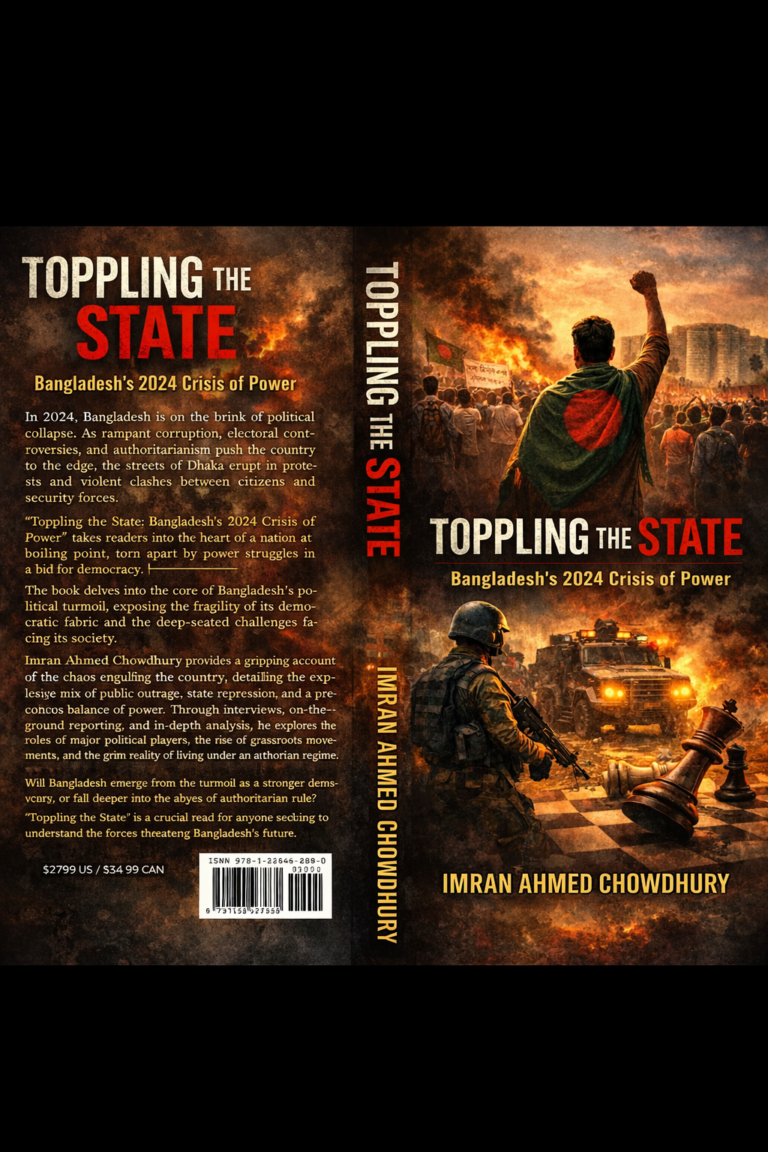
Toppling the State: Bangladesh’s 2024 Crisis of Power is a searching, unsparing examination of how a nation born through liberation arrived at a moment where power shifted without tanks, constitutions remained intact while authority collapsed, and democracy stood suspended between deferral and dismantling.
The political rupture of 2024 in Bangladesh did not resemble the coups of the past. There were no radio announcements, no martial law proclamations, no visible seizure of the state. Instead, the collapse unfolded through silence, hesitation, street mobilisation, narrative capture, and institutional fatigue. What appeared to many as a spontaneous uprising was, in reality, the outcome of layered forces converging over time—historical grievance, student unrest, ideological drift, geopolitical interest, and profound miscalculation by the state apparatus.
This book traces that convergence in depth. It begins with the quota movement that ignited student resistance and opened the floodgates of protest, examining how a legitimate grievance evolved into a nationwide destabilising force. It explores how operational sophistication, covert logistical support, and narrative infiltration transformed dissent into momentum—and how complacency and assessment failure at the highest levels of government allowed events to outrun authority.
Moving beyond the streets, the book interrogates the roles of key institutions: the military that did not stage a classic coup yet remained central to outcomes; intelligence agencies caught between observation and intervention; a judiciary and bureaucracy paralysed by uncertainty; a media ecosystem that amplified rather than arbitrated; and an NGO–activist nexus that stepped into the vacuum of power while claiming neutrality. It asks hard questions about interim governance, unelected authority, and the illusion that democracy can be “managed” back into existence.
The analysis situates Bangladesh’s crisis within a wider geopolitical frame. Positioned at the crossroads of the Bay of Bengal and the Indian Ocean, the country has become a strategic hinge in global rivalries involving the United States, China, India, and the wider Islamic world. The book examines how Bangladesh’s demographic weight, economic rise as the world’s leading ready-made garment producer, and vast youth population intersected with foreign interests, ideological currents, and regional anxieties—turning internal instability into an international concern.
At its core, Toppling the State is a study of political culture. It confronts an uncomfortable historical pattern: the inability of Bangladeshi leaders to leave office honourably, the normalisation of rupture over retirement, and the resulting exhaustion of democratic habit. Through philosophical reflection and historical comparison, the book asks whether Bangladesh’s democracy was merely postponed—or quietly hollowed out.
Written with candour, restraint, and lived insight, this is neither a partisan manifesto nor a conspiracy chronicle. It is a reckoning with power exercised and power withheld, with voices mobilised and voices marginalised, and with a republic still struggling to reconcile its liberation ideals with its political realities.
For readers seeking to understand not just what happened in 2024, but why it happened—and what it means for Bangladesh’s future—this book offers a rigorous, unsettling, and essential account.