
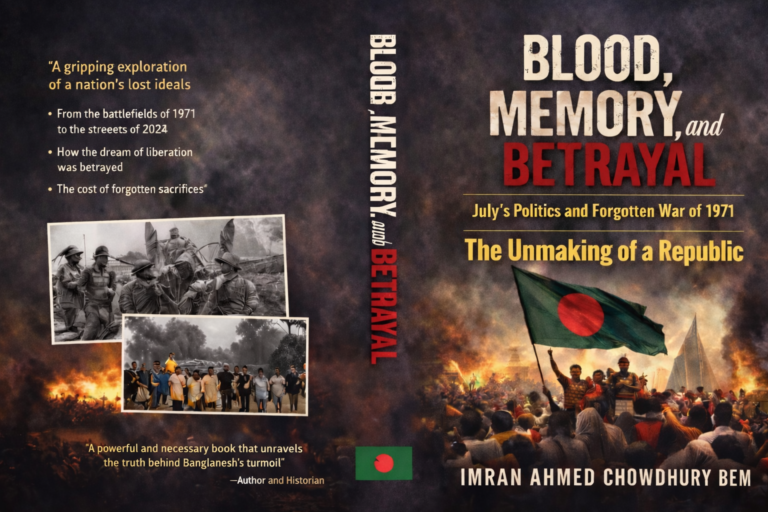
Blood, Memory, and Betrayal
July’s Politics and the Forgotten War of 1971
The Unmaking of a Republic
Imran Ahmed Chowdhury BEM
Preface
This book was not written in haste, nor in anger alone. It was written out of a deep and enduring concern for a nation whose birth was consecrated in blood, sacrifice, and extraordinary moral courage, yet whose present appears increasingly detached from that founding spirit.
Bangladesh emerged in 1971 through one of the twentieth century’s most profound struggles for self-determination. The Liberation War was not merely a military conflict; it was a civilisational moment. It represented a collective assertion of dignity, language, culture, and democratic aspiration against tyranny. Millions paid for that assertion with their lives. Millions more bore scars—physical, psychological, and moral—that continue to shape our society today.
For those of us who grew up in the shadow of that war, history was not an abstraction. It was a lived experience. It was present in refugee camps, in destroyed homes, in broken families, and in the silences that followed trauma. It was present in the stories of resistance, in the sacrifices of ordinary villagers, students, soldiers, and civil servants who chose principle over safety. It was present in the conviction that independence was not an end in itself but the foundation of a just and accountable republic.
Yet, as decades passed, something unsettling began to occur.
The memory of 1971 gradually became politicised, simplified, and selectively deployed. Complex histories were reduced to slogans. Moral struggles were turned into partisan instruments. Institutions that should have preserved historical truth often became arenas of competition and distortion. In this process, remembrance gave way to ritual, and reflection gave way to rhetoric.
The events surrounding the July 2024 movement marked a critical moment in this long trajectory. What began as a student-led protest against specific policies evolved into a nationwide political rupture. It exposed deep fractures within society—between generations, between memory and immediacy, and between ideals and expediency. It revealed how easily historical narratives can be reinterpreted, reappropriated, or erased when power is at stake.
This book seeks to examine that moment not in isolation, but as part of a wider historical continuum. It asks how a nation born in resistance has come to tolerate institutional erosion. It explores how revolutionary language can coexist with democratic regression. It investigates how sacrifice can be celebrated in theory while being undermined in practice.
My approach is neither partisan nor nostalgic. It is analytical, reflective, and, where necessary, critical. I write as someone who has observed Bangladesh’s political evolution from multiple vantage points—as a citizen, a former military officer, a researcher, and a member of the diaspora deeply connected to the country’s moral and historical inheritance.
I do not claim infallibility. Nor do I claim exclusive ownership of truth. What I offer instead is an honest engagement with uncomfortable questions—questions that many prefer to avoid. Why has institutional accountability weakened? How has political polarisation hollowed out civic trust? Why do successive generations struggle to relate meaningfully to 1971? And what happens to a republic when its foundational story becomes negotiable?
This book is not an indictment of protest, dissent, or youthful idealism. On the contrary, these have always been vital forces in Bangladesh’s political life. It is, however, a cautionary examination of how movements can be captured, redirected, and instrumentalised by interests far removed from their original purpose.
Nor is this book an attempt to freeze history in a romanticised past. Nations must evolve. Societies must debate. Traditions must be questioned. But evolution without ethical anchors leads not to progress but to drift. Debate without historical literacy produces noise rather than insight. Reform without institutional integrity creates cycles of instability.
At its core, this work is about responsibility—of leaders, of institutions, of intellectuals, of media, and of citizens themselves. Independence was not granted to Bangladesh as a symbolic achievement; it was entrusted to its people as a moral obligation. That obligation remains unfinished.
I have written this book in the hope that it will encourage thoughtful reflection rather than emotional reaction, dialogue rather than denunciation, and scholarship rather than slogans. If it unsettles some readers, that is not accidental. Democracies cannot survive on comfort alone. They require periodic confrontation with inconvenient truths.
Above all, this book is dedicated to those whose sacrifices made Bangladesh possible, and to those who continue to believe that the Republic can still be renewed—not through amnesia, but through honest remembrance; not through division, but through principled disagreement; not through betrayal, but through responsibility.
If this work contributes, even modestly, to restoring seriousness to our national conversation, it will have served its purpose.
Imran Ahmed Chowdhury BEM
Index
PART I — BIRTH OF A MORAL STATE (1971–1975)
Foundations, sacrifice, and original purpose
1. The Republic Born in Blood
Liberation War, genocide, mass resistance, moral legitimacy of independence.
2. Refuge, Resistance, and Resilience
Refugee camps, Indian support, civilian suffering, collective endurance.
3. Soldiers, Students, and Villagers
How ordinary people became freedom fighters.
4. Memory as a National Asset
How 1971 initially shaped identity, governance, and ethics.
5. From Victory to Vulnerability
Post-war reconstruction and early institutional fragility.
PART II — EARLY DISTORTIONS (1975–1990)
Coups, militarisation, and ideological drift
6. The Assassination and Its Aftermath
1975 as a moral rupture.
7. Barracks and the Ballot
Military rule and controlled democracy.
8. Islamisation and Identity Reengineering
Changing national narratives.
9. The Normalisation of Emergency Politics
Authoritarian habits become routine.
10. Silenced Histories
Suppression and selective remembrance.
PART III — MANAGED DEMOCRACY (1991–2006)
Electoral politics without institutional depth
11. Return to Civilian Rule
Hopes of democratic consolidation.
12. Politics of Vendetta
Personalisation of power.
13. Media, Money, and Muscle
Rise of political patronage networks.
14. Youth Without Civic Education
Failure to institutionalise historical literacy.
15. The Caretaker Compromise
Crisis management is replacing reform.
PART IV — CENTRALISATION AND CONTROL (2007–2023)
Authoritarian stability and hollow institutions
16. Emergency and Technocracy
2007–08 as precedent.
17. One-Party Dominance
Weakening of pluralism.
18. Development Without Democracy
Economic growth vs political rights.
19. Surveillance and Self-Censorship
Shrinking civic space.
20. Institutional Fatigue
The judiciary, police, and bureaucracy are under strain.
PART V — THE JULY RUPTURE (2024)
From protest to political earthquake
21. Origins of the Student Movement
Quota reform and economic frustration.
22. From Grievance to Insurrection
How demands escalated.
23. Streets, Social Media, and Spectacle
Digital mobilisation and misinformation.
24. Policing, Violence, and Loss
State the response and human cost.
25. The Capture of Protest
External and internal political hijacking.
PART VI — MEMORY UNDER ATTACK
Rewriting 1971 in real time
26. Reframing Liberation
Revisionist narratives.
27. The New Heroism
Replacing historical sacrifice.
28. Generational Amnesia
Why youth struggle with 1971.
29. Cultural Institutions in Retreat
Museums, textbooks, archives.
30. Media as Battlefield
Competing realities.
PART VII — THE UNMAKING OF THE REPUBLIC
Institutional and moral collapse
31. Leadership Without Legitimacy
Crisis of authority.
32. Fragmented Citizenship
Polarised society.
33. The Hollow State
Form without substance.
PART VIII — RESPONSIBILITY AND RENEWAL
Paths forward
34. Who Failed Bangladesh?
Shared accountability.
35. Remembering Forward
Rebuilding memory, ethics, and institutions.