
The Annual Betrayal: When Homecoming Becomes a National Crisis
Every year, Bangladesh witnesses a profound movement of the heart. As Eid approaches, millions of souls depart the concrete confines of Dhaka to find sanctuary in their ancestral villages. This should be a poetic display of national unity—a “human tide” of affection where students, labourers, and professionals return to the embrace of their parents.
Instead, this sacred journey has mutated into a harrowing gamble with death. The “new era” promised after the political upheavals of 2024 and the 2026 elections feels like a bitter lie to someone clinging to a train roof.
A Symphony of Institutional Neglect
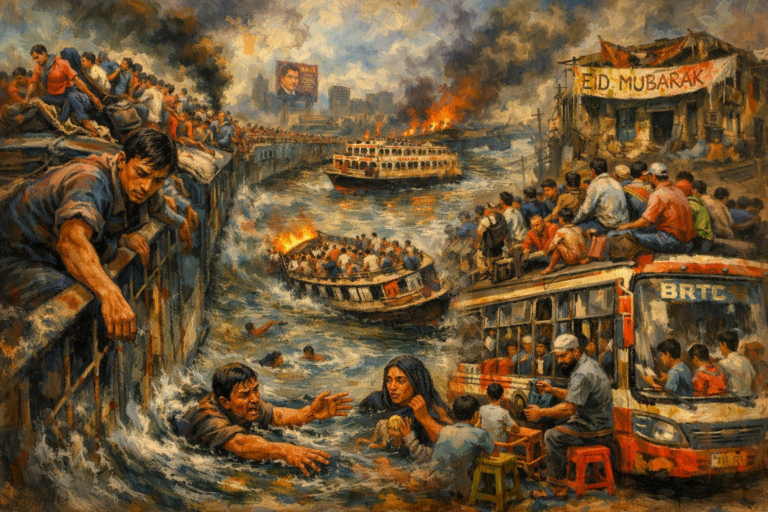
The current state of travel is not a series of unfortunate accidents; it is a structural failure of the Republic. Despite the change in leadership, the scene at Kamalapur and Sadarghat remains a tableau of desperation:
-
The Railways: Human beings are packed into carriages like inanimate freight, with hundreds forced onto rooftops, treating the tracks as an altar for potential sacrifice.
-
The Roads: Transportation syndicates continue to fleece the public with “sky-high” fares, while even state-run BRTC buses are seen crammed with passengers on stools, flouting every safety mandate.
-
The Waterways: Recent collisions at Sadarghat, resulting in deaths and disappearances, prove that even the rivers offer no refuge from the chaos.
The Social Contract: A One-Sided Deal
There is a stinging irony in the current political landscape. The administration of Prime Minister Tarique Rahman ascended on the wings of “reform” and “rule of law”. However, the state’s response to the year’s most predictable event consists of hollow press releases and disregard for safety guidelines.
The Central Indictment: If a government cannot secure a citizen’s journey to their mother’s house, how can it claim to secure the future of a democracy?
The general public is left to wonder if the recent political transition was a genuine attempt at governance or merely a “changing of the guard”. When the faces at the top shift but the machinery of indifference remains intact, the citizen is no longer a person—they are disposable cargo.
The Failure of Society and Authority
This crisis reveals a deep-seated fracture in our social fabric. We have become a society where:
-
Authority is Reactive, Not Proactive: Officials wait for the tragedy to occur before “expressing shock,”, even though they know the exact date of the rush months in advance.
-
Greed is unregulated: transport owners exploit the spiritual longing of the poor, turning a religious obligation into a profit-making machine.
-
Life is Cheapened: With road traffic deaths estimated at over 31,000 annually (per WHO data), we have become desensitised to a mortality rate that should be treated as a national emergency.
Conclusion: From Reunion to Evacuation
Eid is a civilisational heartbeat; it is the one time a garment worker and a banker share the same dream of home. A decent state would honour that dream. Instead, the Bangladeshi state exploits it.
The rhetoric of “national renewal” will remain hollow until the journey home is defined by dignity rather than fear. Eid should be a celebration of life, not a desperate evacuation from a system that has failed its people.