

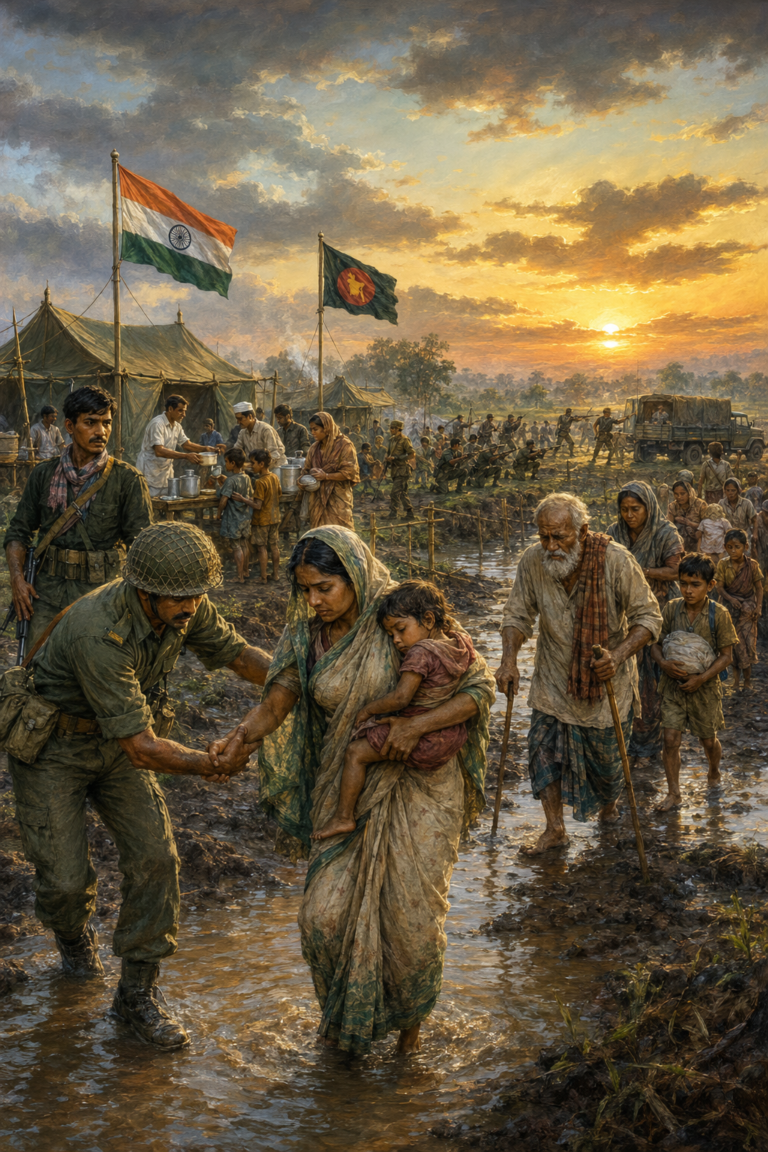
AN HISTORICAL NARRATIVE
India in 1971: The God-Sent Friend of Bangladesh
Ten Million Refugees, a War of Liberation, and the Unpayable Debt of a Nation
Imran Chowdhury
INDIA IN 1971 – THE GOD-SENT FRIEND OF BANGLADESH
Contents
Author’s Note
Prologue: The Light Beyond the Border
Chapter One: A Nation Walks into Exile
Chapter Two: Hunger, Disease and the Work of Mercy
Chapter Three: The Price Paid by India
Chapter Four: A Government in Exile Finds a Home
Chapter Five: From Frightened Youths to the Mukti Bahini
Chapter Six: Bridges, Rivers and the Science of Resistance
Chapter Seven: India Carries Bangladesh to the World
Chapter Eight: Moscow, the Veto and the Shield Against Isolation
Chapter Nine: December – When the Hidden War Became Open
Chapter Ten: The Blood India Gave
Chapter Eleven: The Long Road Home
Chapter Twelve: Magnanimity, Interest and the Unpayable Debt
Historical Note on Numbers and Claims
Sources and Further Reading
In the darkest hour of Bangladesh, India did not merely open a border. It opened its homes, granaries, hospitals, treasury, diplomatic service and, finally, the lives of its soldiers.
INDIA IN 1971 – THE GOD-SENT FRIEND OF BANGLADESH
Author’s Note
This book uses the phrase “God-sent friend” as a human metaphor, not as a theological claim and not as an invitation to replace history with worship. In 1971, millions of Bengalis experienced the destruction of ordinary life with terrifying speed. Villages burned, families scattered, roads filled with the displaced, and a frightened population crossed into India because there was nowhere else close enough, large enough or willing enough to receive it. To a mother carrying a hungry child, the country that said, “Come in; first survive,” could naturally feel like a deliverance sent by Providence.
Bangladesh won its freedom through the resistance, sacrifice and political will of its own people. The freedom fighters were not passive recipients of independence. They fought, gathered intelligence, sabotaged the occupation’s communications, organised civil administration and paid in blood. Yet courage alone does not automatically create food, sanctuary, ammunition, training grounds, diplomatic recognition, air cover or a secure rear base. India supplied those conditions on a scale no other country did. Other governments and international agencies contributed relief, and the Soviet Union provided decisive diplomatic protection. Those contributions deserve recognition. But only India combined mass refuge, political sanctuary, military training, arms, logistics, diplomacy and direct war. In that complete and practical sense, India was Bangladesh’s only full-spectrum state ally in its hour of extinction.
The emotional argument of this book is therefore joined to a discipline of fact. Numbers relating to war, refugee mortality and total expenditure differ across official records and later studies. Where the evidence is incomplete, the uncertainty is stated. The widely repeated claim that India spent about one billion US dollars is best understood as a broad description of the combined humanitarian, security and military burden, rather than as a single audited refugee-relief account. Likewise, the India-Soviet Treaty of Peace, Friendship and Co-operation signed in August 1971 lasted twenty years, not twenty-five. The twenty-five-year treaty was the India-Bangladesh friendship treaty of 1972.
Historical gratitude does not require Bangladesh to surrender its sovereignty or approve every later policy of an Indian government. Friendship between equal nations permits disagreement. What it cannot honestly permit is the erasure of 1971. This book asks the reader to remember a simple truth: when Bangladesh was bleeding, India did not look away.
INDIA IN 1971 – THE GOD-SENT FRIEND OF BANGLADESH
Prologue: The Light Beyond the Border
In the spring of 1971, the roads of East Pakistan became roads of flight. Families moved at night to avoid aircraft and patrols. A farmer who had never travelled beyond his market town suddenly had to lead his children through fields, rivers and unfamiliar forests. A widow carried a brass key tied into the corner of her sari, as if possession of the key might guarantee that the house would still be standing when she returned. An old man who could no longer walk was placed on a bamboo frame. Infants were kept quiet against their mothers’ bodies. A cooking pot, a little rice, a family photograph and a change of clothing became the portable remains of an entire life.
Behind them lay the violence unleashed by the Pakistan Army on the night of 25 March. Operation Searchlight struck Dhaka and then spread through towns and rural districts. Students, political workers, members of the police and East Pakistan Rifles, teachers, professionals, Hindus and suspected supporters of Bengali nationalism were hunted. The pattern differed from place to place, but the meaning was unmistakable: the election verdict of 1970 would not be honoured through peaceful constitutional transfer; Bengali political aspiration would be suppressed by force.
For ordinary people, there was no time to debate the language of international law. They knew the sound of gunfire, the glow of burning homes and the terror of a missing son. Their immediate map had only two directions. Behind them was danger; ahead was the Indian border.
Across the world, governments issued statements. Some expressed concern. Some treated the crisis as Pakistan’s internal affair. Some remained tied to Islamabad by military, diplomatic or Cold War interests. Statements mattered, but a starving child could not eat a statement. A wounded villager could not be carried to safety by an expression of concern. Survival required real territory, real rice, real water, real medicine and real protection. India provided them.
This was not an easy gesture made by a wealthy country with limitless reserves. India in 1971 was a developing state facing poverty, food insecurity, unemployment, fragile infrastructure and its own communal and regional tensions. It had fought wars in 1962 and 1965 and continued to face hostile borders. Yet it did not close the gates. The border became not merely a line between states but a vast emergency entrance into life.
The phrase “India was the only friend” needs precision. Britain, France, humanitarian organisations, journalists, church groups, citizens in many countries, the United Nations system and the Soviet Union all played roles of varying importance. But ask a more demanding question: which state accepted almost ten million people, hosted the government in exile, trained and armed the resistance, carried the cause into world capitals, deployed its armed forces on two fronts and accepted the deaths of its own soldiers? The answer is one state. India.
That answer does not diminish the Bengali struggle. It explains how the struggle survived long enough to prevail. A friend does not win your freedom in your place. A true friend makes it possible for you to continue fighting for it. In 1971 India became the rear area, hospital, warehouse, training ground, diplomatic microphone and, finally, battlefield partner of Bangladesh.
The following pages tell that story through the human flood at the border, the refugee camps and the people beyond them; through cholera wards, ration queues and Indian families who shared food they could scarcely spare; through the Mujibnagar Government, the camps of the Mukti Bahini, the explosives used against bridges and railway lines, the naval commandos and the first fragile wings of the Bangladesh Air Force; through Indira Gandhi’s diplomatic campaign, the treaty with Moscow and the Soviet vetoes; and through the thirteen-day conventional war that ended with surrender in Dhaka.
At every stage, the reader should remember the scale of the choice India made. It could have pushed the refugees back. It could have offered sympathy without sanctuary. It could have restricted help to covert gestures. Instead, it accepted a burden that reached into the budget of the state, the price paid by the consumer, the workload of the railway employee, the sleep of the doctor, the ration of the village family and the life of the soldier. In the darkness of 1971, the light beyond the border had a name: India.
INDIA IN 1971 – THE GOD-SENT FRIEND OF BANGLADESH
Chapter One: A Nation Walks into Exile
The flood that became ten million
The refugee movement did not grow at the measured pace of an ordinary migration. It came as a human flood. By 12 May 1971, Indian figures recorded more than 2.3 million arrivals, with roughly 50,000 people entering each day. At moments the daily flow rose still higher. By the end of the year, the total had approached ten million, one of the largest sudden refugee movements since the Second World War.
Numbers of such magnitude can numb the imagination. Ten million becomes a phrase spoken quickly, almost too large to see. It must instead be understood as ten million separate crossings. Each person had a name, a home, a fear and something left unfinished. A child abandoned a schoolbook. A shopkeeper left the shutters open. A farmer left cattle untethered. A family separated in a night attack hoped to find one another in a camp whose name they did not know. The political crisis of a country became millions of private catastrophes.
The principal receiving areas were West Bengal, Tripura, Assam and Meghalaya. Later, refugees were moved to other parts of India, including Bihar, Uttar Pradesh and Madhya Pradesh, because the border states could not carry the pressure alone. Tripura faced an especially astonishing burden: the refugee population at points came close to, or exceeded, the scale of its own settled population. Schools, colleges, warehouses, religious premises, railway surroundings and open fields were converted into emergency shelter.
India established hundreds of camps. Accounts vary, but contemporary and scholarly sources commonly refer to roughly 825 or more. These were not tidy settlements prepared in advance. They were improvised under relentless pressure. Bamboo frames had to be raised, tarpaulins found, water points dug, latrines built, kitchens organised and registration systems created while new families continued to arrive. Monsoon rain turned paths into mud. Drainage failed. Crowding amplified disease. Tempers rose under hunger and uncertainty. Yet the camps represented a decisive moral difference: behind the refugees was a force that might kill them; before them was a state trying, however imperfectly, to keep them alive.
By early December, approximately 6.8 million refugees were recorded in camps and about 3.1 million were living with relatives, host families or in other arrangements. A contemporary United States assessment also estimated that around three million people were outside formal camps. These figures matter because the familiar photograph of a ration queue tells only part of the story. Beyond the registered camp stood another immense population, harder to count and much harder to serve.
Outside the camps
Some families lived beside roads under cloth tied to bamboo. Others found space near railway lines, in market verandas, abandoned buildings, forest clearings or at the foot of hills. Memories from Kolkata and border districts describe people sleeping in slums, under trees, around culverts and sometimes inside the large concrete pipes intended for drainage works. Such testimony should not be turned into a falsely exact map of every shelter. Its importance lies in revealing the condition of the unregistered and dispersed: families visible to passers-by but easily invisible to administration.
For a government, a registered camp can be assigned a store, a medical post and a ration list. A family in a roadside encampment may have no card, no established water source and no official responsible for its welfare. Reaching such people required mobile relief, local knowledge, volunteer networks and repeated searches. It also required compassion from ordinary Indians who could not wait for an instruction from Delhi.
A cup of milk could determine whether an infant lived. A dry cloth could restore a mother’s dignity. A blanket could give an old man one more night. India had to obtain and distribute rice, lentils, oil, salt, onions, powdered milk, medicines, oral rehydration supplies, clothing, sheets, bedding, cooking utensils, bamboo, tarpaulin and fuel. No system could fully satisfy a need of this scale. There were long queues, shortages, administrative failures and deaths that should never be romanticised. But imperfection does not cancel generosity. It reveals the impossible dimensions of the responsibility India accepted.
India already had millions of citizens whose housing, nutrition and employment were insecure. The arrival of almost ten million more people placed pressure on markets, transport, hospitals, public finances and local relations. Yet the refugees were not collectively returned to the guns. That single fact must be held firmly in memory. In 1971, India’s open border was not an abstract policy; it was the largest refuge Bangladeshis had.
The border as a living institution
The India-East Pakistan frontier stretched for roughly 4,000 kilometres through rivers, tea gardens, paddy fields, hills, forests and densely inhabited settlements. It was never a simple fence line. To receive civilians while monitoring Pakistani incursions, facilitating the movement of the resistance, controlling arms, transporting relief and maintaining security required a huge human and logistical apparatus.
The Border Security Force played an early and vital role. Its posts became points of reception, communication and support. Indian police, civil servants, railway staff, engineers, drivers, health officials, military personnel and volunteers formed a network behind the frontier. Every camp required administrators and guards. Every shipment required a route, vehicles, fuel, manifests, warehouses and people to unload it. Every injured freedom fighter needed evacuation. Every outbreak of disease required warning and response.
It is easy to write “India gave shelter” as if shelter were a tent placed once and then forgotten. Shelter for millions was a daily operation. Rice had to arrive again tomorrow. Water had to remain safe after rain. A missing child had to be identified. The dead had to be buried or cremated. Records had to be maintained so that international assistance could be requested and distributed. Roads and bridges damaged by weather or traffic had to be repaired. The border was therefore not simply open; it was kept open by continuous labour.
This is the first measure of India’s greatness in 1971. It did not merely permit entry. It created, under immense strain, an entire architecture of survival.
INDIA IN 1971 – THE GOD-SENT FRIEND OF BANGLADESH
Chapter Two: Hunger, Disease and the Work of Mercy
Rice, milk, medicine and the dignity of survival
Food in a refugee crisis is both nourishment and order. When people have lost land, work and household stores, a regular ration becomes the fragile rhythm of life. Indian authorities had to calculate requirements for populations that changed daily. Grain moved through national and state systems into border regions already under pressure. Lentils, oil, vegetables, salt, onions and fuel had to follow. Infants required milk; the sick needed diets that a mass kitchen could not always provide.
The practical details were endless. Food had to be protected from rain and vermin. Kitchens needed utensils and firewood. Queues had to be organised in a way that did not exclude the elderly, the disabled or mothers with children. Distribution lists had to recognise new arrivals. Fraud and diversion had to be controlled without turning desperate people into suspects. In places, the ration was inadequate. In others, local initiative filled the gap. Relief was not a single act of giving but millions of repeated acts of procurement, transport, accounting and human judgement.
Clothing and bedding were no less important. Refugees who arrived soaked by rain or river crossings required dry garments. Women needed privacy and sanitary supplies. Families sleeping on wet ground needed mats, sheets, blankets and pillows. Tarpaulin without drainage became a pool; a bamboo shelter without proper anchoring could collapse in a storm. A humane response therefore had to notice the small objects by which people preserve health and self-respect.
The Indian public gave on a scale that cannot be reduced to government statistics. Students collected clothing. Trade unions and religious organisations raised funds. Artists, writers and musicians made the suffering visible. Doctors volunteered. Women donated jewellery, objects carrying not only monetary value but family memory and personal security. A poor household that shared a measure of rice might appear insignificant beside a national budget, yet that sharing contained the moral centre of India’s response.
The refugee was not always welcomed without tension. Prices rose; wages and housing came under pressure; local people sometimes feared disease or competition. There were arguments, prejudice and fatigue. Honest history must acknowledge them. Magnanimity is not the absence of strain. It is the decision to keep helping despite strain. India was not a land without scarcity; it was a land that divided its scarcity with Bangladesh.
Cholera and the monsoon
The monsoon transformed congestion into a public-health emergency. Flooded ground contaminated water sources. Cholera and severe diarrhoeal disease spread rapidly. Malnutrition weakened resistance. Children and the elderly were particularly vulnerable. Camps such as those in the Salt Lake area became symbols of an epidemic struggle fought with too few beds and too many patients.
Recent demographic research suggests that excess refugee mortality may have been substantially higher than older official counts acknowledged. The precise total remains a subject for continuing research, and no responsible account should pretend certainty where records were incomplete. What is beyond dispute is the scale of suffering: thousands upon thousands of exhausted people faced infection, dehydration and hunger in environments constructed almost overnight.
India had to establish temporary hospitals, dispensaries, vaccination programmes, tube wells, sanitation facilities and nutrition centres. Medical work required far more than doctors. Nurses, laboratory workers, pharmacists, cleaners, drivers, clerks and public-health officers were essential. Medicines needed refrigerated or protected transport. Patients had to be moved by ambulance or truck. Water points needed testing. Corpses had to be handled with dignity and speed to protect public health.
International actors assisted. United Nations agencies, the World Food Programme, UNICEF, the World Health Organization, the Red Cross, Oxfam, Caritas and other organisations supplied expertise, money, food or medicine. Their work deserves honour. Yet international relief did not descend directly into a child’s hand. It arrived on Indian territory, through Indian ports, airports, railways, warehouses and roads. Indian institutions secured it, moved it and delivered it. The host state bore the final-mile burden.
This distinction explains why India was more than one donor among many. It was the ground on which every relief effort had to stand. Without India, there was no immense safe space in which the refugees could be registered, treated and fed. Other hands helped to carry the load; India provided the shoulders.
The invisible workforce
Behind famous speeches stood an army of civilian work. Officials were appointed or transferred to refugee administration. Teachers lost classrooms to camps and adapted. Railway employees added special movements to already crowded systems. Engineers found water and reinforced roads. Accountants managed emergency expenditure. Police protected stores and mediated disputes. Translators and local guides helped people navigate unfamiliar districts. Postal and telecommunication staff carried messages between dispersed agencies.
The government also had to protect a long and active frontier. Pakistani forces sometimes fired across it, pursued insurgents or attempted to disrupt support networks. The same roads moved civilians, relief, recruits, weapons and troops. Separating those flows while maintaining secrecy and security demanded coordination between the civil administration, the BSF and the armed forces.
Every description of India’s help should therefore move beyond sacks of grain and rows of tents. India mobilised people. It hired, reassigned and exhausted public servants. It spent not only money but administrative attention, at a time when every ministry had other national duties. A crisis of Bangladesh became a daily duty of the Indian state.
At night, when the ration line ended, the work did not. A sick child still needed observation. A truck delayed by rain still had to arrive. A newly crossed family still needed a place. That endurance is why the refugees survived in such numbers. In their darkest season, India was not merely sympathetic. India was present.
INDIA IN 1971 – THE GOD-SENT FRIEND OF BANGLADESH
Chapter Three: The Price Paid by India
What does “one billion dollars” mean?
The statement that India spent about one billion US dollars on the Bangladesh crisis appears in books, speeches and recollections. It conveys a broad truth: the burden was enormous. But a careful historian must ask what is included. Is the figure limited to food and shelter for refugees? Does it include administration, border security, transport, the training and maintenance of the Mukti Bahini, the mobilisation of Indian forces, the December war and post-war assistance? Different answers produce different totals.
India’s Economic Survey for 1971-72 reported that by the end of January 1972 approximately 260 crore rupees had been spent on refugee relief and that expenditure would continue to rise. A contemporary multilateral estimate for the full financial year’s refugee requirement was around 700 million US dollars. Other contemporary calculations described a daily cost of roughly 2.5 million dollars during parts of the crisis. None of these figures, standing alone, captures the entire strategic and military burden.
It is therefore safest to describe one billion dollars as an approximate scale for the broader human, logistical, security and war-related cost, not as a single final audited relief bill. This caution strengthens rather than weakens the argument. Even the directly recorded refugee expenditure was staggering for a country with India’s income and development needs. When training, arms, border deployment, full military mobilisation and war are added, the national sacrifice was plainly greater.
Money spent on emergency survival is also money not spent elsewhere. A rupee used for a camp clinic could not at the same moment fund an Indian school, irrigation project or village road. Foreign exchange used for essential imports could not support another development priority. Refugee expenditure strained budgets, contributed to inflationary pressure and complicated economic planning.
The meaning of the cost is thus not captured by conversion into dollars. India used part of its future to protect Bangladesh’s present. It postponed some of its own aspirations so that another people might live long enough to realise theirs.
Austerity, taxes and public sacrifice
The burden reached the Indian public through fiscal measures and restraint. Government non-plan expenditure was reduced. Recruitment, travel, telephones, vehicles and other administrative costs were curtailed. Ministers accepted reductions in salary. Additional taxation and surcharges were introduced, including measures associated in public memory with refugee relief. Railway taxation and other revenue devices made distant citizens contribute to a crisis they might never see with their own eyes.
These policies hurt. India faced poor harvests, unemployment and rising essential prices. Rice, pulses, oil and onions did not become cheaper because refugees needed them; demand rose. Receiving areas felt the first shock, while the national economy carried it through procurement and public finance.
The phrase “India helped Bangladesh” can sound like a government cheque. In reality it was paid by Indian citizens: the passenger buying a ticket, the employee accepting restraint, the family facing higher prices, the taxpayer surrendering income and the village sharing grain. Bangladesh’s independence drew upon India’s treasury, filled by the work and sacrifice of its people.
India was not rich, which made the choice more powerful. Generosity from scarcity is unforgettable. The state could not solve every problem or prevent every refugee death, but it rejected the cheaper policy of closing the border and protecting its budget. It chose a more expensive humanity.
The four-thousand-kilometre burden
Security expenditure formed another vast layer. The frontier had to be watched across roughly 4,000 kilometres. BSF units and later the Indian Army supported reception, protected routes, monitored Pakistani activity and sustained the resistance. Troops required bases, rations, ammunition, vehicles, medical care and communications. Roads and bridges had to carry extraordinary traffic. Airfields and railheads became components of an increasingly integrated war effort.
This deployment began long before the conventional war of December. From the first phase of resistance, India was supplying a sanctuary in which fighters could reorganise. Pakistani pressure near the border and the growing intensity of operations meant that India lived for months in a condition between peace and war. It bore the costs of preparation without certainty about when, or under what diplomatic conditions, open war would begin.
Readiness also extended to the western frontier. India could not concentrate everything in the east and assume Pakistan would remain passive. Forces and reserves had to cover a continental theatre; when war came, India would fight in east and west.
Thus the refugee camp and the military cantonment were connected. Both were consequences of Pakistan’s attempt to crush Bengali self-determination. Both demanded money and labour from India. The camp protected the people; the military preparations protected the possibility that they might one day return home.
To call India the only complete friend of Bangladesh in 1971 is not rhetorical excess when the whole ledger is examined. No other state combined the daily cost of ten million displaced people with the strategic cost of a two-front war. India did.
INDIA IN 1971 – THE GOD-SENT FRIEND OF BANGLADESH
Chapter Four: A Government in Exile Finds a Home
Mujibnagar and the survival of legitimacy
An independence movement needs more than fighters. It needs political authority, administration, money, communications, international representation and a believable claim to govern. After the crackdown, Bengali leaders who escaped the killing and arrests faced the immense task of turning the electoral mandate of 1970 and the declaration of independence into a functioning state apparatus.
The Provisional Government of Bangladesh was formally constituted on 10 April 1971 and sworn in on 17 April at Baidyanathtala in Meherpur, later named Mujibnagar. Sheikh Mujibur Rahman, imprisoned in Pakistan, was declared President; Syed Nazrul Islam served as Acting President and Tajuddin Ahmad as Prime Minister. The ceremony occurred on Bengali soil, but the government’s durable working base developed in Kolkata under Indian protection.
India provided the secure environment in which ministries, secretariats, military coordination, information services and diplomatic missions could function. Offices required buildings, communications, transport, printing, security and access to Indian officials. Ministers and civil servants needed the freedom to move. Journalists had to be briefed. Funds had to be administered and the war effort coordinated. Without a safe rear area, the government might have existed only as a declaration. India gave it the practical room to behave like a state before the state had secured its territory.
The importance of that sanctuary is difficult to exaggerate. Pakistan wanted to present the conflict as an internal security operation against criminals and separatists. The Mujibnagar Government embodied an opposing truth: the elected representatives of the Bengali majority had formed a government and were directing a national liberation struggle. Its presence allowed Bangladesh to speak in its own political name rather than appearing merely as an object of Indian policy.
Bangladeshi diplomatic missions and representatives worked in Kolkata, Delhi, London, Washington, New York, Stockholm and elsewhere. Delegations approached foreign governments, international bodies and the United Nations. Bengali diplomats defected from Pakistani service and declared allegiance to Bangladesh. Their courage was their own, but the network of safety, travel and communication through which they operated depended heavily on India.
Here again the character of friendship matters. India did not simply speak instead of Bangladesh. It helped Bangladesh acquire a voice and a platform. A powerful friend can smother a smaller ally by taking over its cause; India, despite inevitable tensions and influence, enabled the provisional government to retain the legal and political identity of the struggle.
A state built in wartime
The government in exile had to perform contradictory tasks at once. It had to plan for liberation while caring about territory it did not yet control. It needed to maintain unity among political leaders, military officers, student activists and diverse guerrilla groups. It had to communicate with a traumatised population inside occupied Bangladesh and with refugees scattered across India. It needed foreign sympathy, material aid and eventually recognition.
India’s officials became interlocutors, facilitators and sometimes difficult partners. There were debates about military priorities, political influence and the organisation of forces. Mature history should not erase these disagreements. Allies do not become identical. Tajuddin Ahmad and his colleagues had Bangladeshi responsibilities; Indian leaders had Indian strategic concerns. The achievement was that these interests were brought into a working relationship strong enough to sustain the war.
The existence of an organised provisional government also helped discipline the resistance. Sector commands, training arrangements and military planning could be linked to political authority. Relief for refugees and support for fighters could be coordinated with a vision of the state that would return. A liberation war without government risked fragmentation; a government without a secure base risked irrelevance. India helped join the two.
The offices in Kolkata may have lacked the grandeur of a capital, but they represented an extraordinary historical fact. Bangladesh existed in administration and aspiration before it was fully free in geography. Behind those offices stood Indian security. Around them operated Indian communication, transport and diplomatic networks. In the worst days, when Dhaka remained occupied and Bangabandhu remained imprisoned, India sheltered not only Bengalis but the very continuity of Bangladesh’s statehood.
For this reason, the debt to India cannot be counted only in meals and bullets. India gave a homeless government a home.
INDIA IN 1971 – THE GOD-SENT FRIEND OF BANGLADESH
Chapter Five: From Frightened Youths to the Mukti Bahini
The making of an organised resistance
The first Bengali resistance was courageous but uneven. Units of the East Pakistan Rifles, police and Bengali elements of the armed forces mutinied or fought back. Students, farmers, workers and political activists joined with little training. Some possessed rifles; others arrived with nothing but anger and a willingness to risk death. Against a professional army equipped with artillery, armour, aircraft and established communications, courage needed organisation.
The BSF offered early assistance, contacts and weapons. As the conflict developed, the Indian Army assumed greater responsibility for systematic training, equipping and logistical support. General S. H. F. J. Manekshaw’s Operational Instruction No. 52 of 1 May set out a framework in which the Eastern Command would assist the liberation forces. Training centres were established in Indian states around the frontier. Recruits learned fieldcraft, weapons handling, map reading, communications, demolition, ambush methods, intelligence gathering and small-unit tactics.
The transformation was profound. A young man who had fled a burned village entered a camp frightened, exhausted and perhaps never having fired a weapon. He left with a unit, a commander, a task and a route back into his country. India did not give him patriotism; Bangladesh had already given him that. India gave his patriotism military form.
Weapons supplied through Indian channels included rifles, light machine guns, submachine guns such as the Sten, grenades, mortars, mines and explosives. The exact mix varied by unit, phase and availability. Some arms had been captured from Pakistani stocks, some came from Indian inventory and some from other sources. What mattered operationally was continuity. A weapon without ammunition is an ornament; a unit without rations cannot remain in the field. India supported not only the initial issue but the supply chain behind it.
Training also required vehicles, fuel, instructors, interpreters, medical support, accommodation and food. Recruits had to be screened and organised. Units needed routes into Bangladesh and guides who understood rivers, villages and Pakistani positions. Injured fighters required evacuation back across the border. Intelligence collected inside Bangladesh had to reach planners and be turned into operations.
Every bullet carried into occupied territory rested upon this invisible structure. The freedom fighter remained the agent of liberation, but India became the indispensable armourer and quartermaster of that agency.
Guerrilla war and the sectors
The Bangladesh Forces divided the country into sectors for command and operations. Sector commanders and sub-sector arrangements coordinated guerrilla activity, conventional forces and intelligence. Indian support interacted with this structure, providing training and material suited to different terrains and missions.
The guerrilla did not always seek to hold ground. The objective was often to make occupation expensive and insecure: ambush a patrol, destroy a bridge, cut a telephone line, attack a river craft, disrupt a railway, seize weapons, intimidate collaborators or gather information. Such operations multiplied the Pakistan Army’s defensive burden. A road that could not be trusted required guards. A damaged railway delayed supplies. A small attack forced a large unit to remain dispersed.
India’s trainers taught more than firing. They taught patience, reconnaissance and withdrawal. An ambush depended on concealment, timing and a secure escape route. Demolition depended on understanding the target, selecting the charge, placing it correctly and avoiding premature explosion. Mine warfare required discipline because a poorly marked mine endangered civilians and comrades.
The camps also created a national experience. Bengalis from different districts met under a shared identity. Students trained beside villagers; defected soldiers instructed civilians; political activists encountered the routine of military command. The training ground was therefore both a military school and a workshop of nationhood.
There were tensions. Units differed in political affiliation, training quality and access to weapons. India sought influence over parts of the resistance and maintained its own assessments of reliability. No liberation movement of such scale is free of rivalry. Yet the central result remains: thousands upon thousands of Bengalis were turned into a sustained fighting force capable of operating across the country.
When Bangladesh remembers the courage of the Mukti Bahini, it should also remember the Indian instructor standing beside a muddy range, the BSF man guiding a group through the border, the driver bringing ammunition, the doctor treating a wound and the planner marking a route. These people did not replace the freedom fighter. They made it possible for him to return.
INDIA IN 1971 – THE GOD-SENT FRIEND OF BANGLADESH
Chapter Six: Bridges, Rivers and the Science of Resistance
Explosives against an occupation
The geography of Bangladesh made bridges, culverts, ferries and railway lines decisive. Rivers divided the country, and roads often depended on a limited number of crossings. The Pakistan Army needed these arteries to move troops, ammunition, fuel and supplies. The Mukti Bahini sought to turn every artery into a vulnerability.
Demolition is more complex than the dramatic phrase “blow up the bridge” suggests. A fighter must know the structure, the amount and type of explosive, the strongest and weakest points, the location of guards, the likely effect on civilian movement and the time needed for withdrawal. Too small a charge may merely scar concrete. Too large or badly placed a charge can kill the team. Detonators, fuses, mines and explosives must be stored and transported safely through heat, rain and patrols.
Indian training gave selected guerrillas these dangerous skills and supplied the necessary materials. Teams learned to cut roads, damage culverts, derail or interrupt railway movement and break communications. The purpose was not destruction for its own sake. It was the systematic isolation of Pakistani units and the erosion of their confidence.
The consequences accumulated. A convoy delayed at a damaged bridge became vulnerable. A garrison without reliable resupply consumed stocks and grew cautious. Communications failures slowed decisions. Troops were diverted to guard infrastructure. The Mukti Bahini’s local knowledge – village paths, river channels, sympathisers and safe houses – combined with Indian training and supply to produce a form of warfare the occupation could never fully control.
This partnership altered the balance. India provided methods and material; Bangladesh provided terrain, intelligence and resolve. Neither element alone would have produced the same effect. The relationship was complementary, not competitive.
The river war and the naval commandos
Bangladesh is a riverine country, and in 1971 waterways were central to commerce and military logistics. Ports, jetties, ferries and inland shipping allowed Pakistan to move supplies where roads were weak. To challenge the occupation, the liberation struggle had to go beneath the surface of the water.
With Indian assistance, Bengali naval commandos received specialised training in swimming, limpet mines, underwater movement, night infiltration and the sabotage of ships and port facilities. Operations associated with the celebrated naval commando campaign struck at Chattogram, Mongla, Chandpur, Narayanganj and other targets. Young men entered dark water carrying explosives, approached vessels under the threat of sentries and currents, attached mines and withdrew before detonation.
The courage was Bengali; the training infrastructure and much of the technical support were Indian. Instructors had to turn good swimmers into disciplined saboteurs. Equipment had to be acquired and tested. Targets required intelligence. Teams needed clandestine insertion and recovery. The resulting attacks damaged vessels, disrupted port activity and announced that Pakistani control of the rivers was insecure.
The Indian Navy’s role extended beyond commando training. As war approached, it prepared to isolate East Pakistan by sea. In December it established pressure in the Bay of Bengal, attacked useful targets and closed the routes by which Pakistan might receive meaningful reinforcement or escape. On the western front, Operation Trident and Operation Python struck Karachi and its maritime infrastructure, forcing Pakistan to confront a naval war on both sides of the subcontinent.
The loss of INS Khukri in the west reminds us that this was not costless strategic theatre. Indian sailors died in a war whose decisive political purpose lay in the liberation of Bangladesh. Their graves may not stand beside the rivers of Bengal, but their sacrifice belongs to the same history.
Kilo Flight: the first wings of Bangladesh
Bangladesh’s emerging air arm began modestly. In September 1971, at Dimapur in India, Bengali pilots, airmen and technicians formed what became known as Kilo Flight. India supplied a Dakota transport aircraft, a DHC-3 Otter and an Alouette helicopter, while providing training facilities, technical help, security and operational preparation.
These were not modern strike aircraft. They had to be adapted for attack. Rockets, machine guns and improvised bomb-carrying arrangements turned ordinary platforms into instruments of a newborn air force. The crews trained for low-level night operations, navigation and surprise. Their limitations increased the danger. They could not depend on speed or sophisticated defensive systems; they depended on skill, darkness and nerve.
From the night of 3 December, Kilo Flight attacked fuel and other targets around Chattogram and Narayanganj. Its material effect was modest beside the Indian Air Force, but its symbolic meaning was immense: Bangladesh’s flag had entered the air war before independence was complete.
India did more than fight with its own aircraft; it helped plant the seed of a Bangladeshi air force. The same was true at sea. A generous ally lends strength and helps a friend build its own. India stood beside the freedom fighters on land, trained commandos for the rivers and helped Bengali pilots rise into the sky.
INDIA IN 1971 – THE GOD-SENT FRIEND OF BANGLADESH
Chapter Seven: India Carries Bangladesh to the World
The diplomatic battlefield
Pakistan attempted to define the crisis as an internal matter. India had to make the world see what that phrase concealed: mass displacement, systematic violence, the refusal to honour an election and a refugee burden destabilising an entire region. The diplomatic struggle was therefore inseparable from the military one.
Indian embassies and missions briefed governments, parliaments, journalists and international organisations. Special envoys travelled across Europe, Asia, Africa and the Americas. The effort reached London, Paris, Moscow, Washington and many other capitals, while Indian representatives worked at the United Nations and in multilateral forums. The popular image of “hundreds of envoys to hundreds of countries” should be understood as a description of the campaign’s breadth rather than a literal count of unique states. The essential point is sound: India’s diplomatic system was mobilised globally for Bangladesh.
The argument had several parts. First, the refugee movement was not a voluntary economic migration but the direct result of military repression. Second, India could not indefinitely absorb almost ten million people. Third, relief alone would treat the symptom while leaving the cause untouched. Fourth, a political settlement respecting the Bengali electoral mandate was necessary for safe return.
Indira Gandhi carried this argument personally. Beginning in late October, she travelled through important Western capitals and met leaders in Europe and the United States. She spoke not only of India’s hardship but of the political origins of the crisis. Her purpose was to create understanding, obtain relief, warn against simplistic pressure for Indian restraint and prepare international opinion for the possibility that war might become unavoidable.
The reception was mixed. Many ordinary people, journalists and parliamentarians responded with sympathy. Governments were more cautious. The Nixon administration remained aligned with Pakistan and viewed the crisis through a Cold War lens involving China and secret diplomacy. China supported Pakistan. Some states feared that accepting India’s case would encourage secession elsewhere. Even where relief was offered, political action lagged.
Yet India’s campaign achieved important results. The suffering of the Bengalis became a permanent subject of international attention. Pakistan could not fully hide the scale of the exodus. Humanitarian assistance increased. India established the moral and strategic argument that the status quo was unsustainable. When war came, it did not arrive in a diplomatic vacuum.
Bangladesh’s own representatives participated and often spoke with moving authority. But India possessed embassies, access, transport, diplomatic recognition and the weight of a major state. It used those advantages repeatedly for a nation that did not yet occupy its own seat at the United Nations. In the world court of public opinion, India became Bangladesh’s loudest recognised voice.
Relief, recognition and the limits of sympathy
The United Nations General Assembly acknowledged the heavy burden carried by India and called for large-scale assistance. International relief was valuable, but it remained insufficient compared with the need. Contemporary estimates suggested that foreign contributions met only a limited portion of actual Indian expenditure during important stages of the crisis.
This imbalance created frustration. The world could praise India for generosity while leaving India to finance most of that generosity. It could send food but avoid confronting the violence that produced the hunger. India insisted that the refugees could not be kept permanently in camps. Their voluntary and safe return required a political transformation inside East Pakistan.
Recognition of Bangladesh became another contested issue. India delayed formal recognition until 6 December, after open war had begun, partly because timing had military and diplomatic consequences. Delay did not mean absence of support. For months India had sustained the political and military foundations of the emerging state. When recognition came, it formalised a reality India had already protected.
The lesson is stark. Sympathy without power is fragile. Many sympathised with Bangladesh, some gave generously, and some exposed atrocities at personal risk. But only India could combine compassion with territory, institutions, armed force and proximity. The world helped; India carried.
INDIA IN 1971 – THE GOD-SENT FRIEND OF BANGLADESH
Chapter Eight: Moscow, the Veto and the Shield Against Isolation
The treaty that bought strategic space
On 9 August 1971 India and the Soviet Union signed the Treaty of Peace, Friendship and Co-operation. It is often wrongly described as a twenty-five-year treaty. Its original term was twenty years, with provisions for renewal. The confusion may arise from the twenty-five-year India-Bangladesh friendship treaty signed in 1972.
The India-Soviet treaty was not a formal military alliance in the simplest sense, but its consultation provisions and political signal were strategically powerful. India faced a difficult alignment: Pakistan enjoyed the support of the United States and China, while China had fought India less than a decade earlier. New Delhi could not assume that a war in the east would remain insulated from wider pressure.
The treaty reduced the danger of Indian isolation. It warned that coercion against India could carry consequences and gave Delhi greater confidence to continue supporting Bangladesh. It also improved the diplomatic balance as military preparations intensified.
The agreement did not make Bangladesh a Soviet creation. Bengali resistance and political legitimacy came from Bangladesh; India’s policy came from its own assessment of security and morality. The Soviet Union provided a strategic shield that allowed the India-Bangladesh partnership to operate under less dangerous international conditions.
This distinction also clarifies the phrase “India was the only friend.” Moscow was a vital friend in diplomacy. Bhutan offered early recognition. Humanitarian organisations and individuals across the world helped. But the Soviet Union did not host ten million refugees or train the Mukti Bahini; it did not send its army to Dhaka. India was the only country whose assistance covered every field. The Soviet role was decisive precisely because it protected India’s ability to perform that unique role.
Vetoes at the United Nations
When open war began in December, the United Nations Security Council became a battlefield of resolutions. Proposals calling for an immediate ceasefire and troop withdrawal risked freezing the military situation before Bangladesh was liberated. A premature halt could have allowed Pakistani forces to regroup and left the political cause unresolved.
The Soviet Union used its veto more than once to block resolutions that India and the Bangladesh leadership considered harmful. On 13 December, a revised draft resolution was again vetoed. These interventions bought precious time. The India-Bangladesh joint forces were moving rapidly toward Dhaka, but every day mattered. A diplomatic decision in New York could have altered the result on the ground.
The veto did not win the battles. Indian and Bangladeshi forces still had to cross rivers, bypass strongpoints, seize towns and confront Pakistani resistance. But military victory requires political time. The Soviet Union helped provide that time.
India’s own diplomacy was the central link. It had secured the treaty, explained its case internationally and worked with Moscow during the crisis. Bangladesh benefited from relationships it could not yet build for itself as an unrecognised state. Once again, India stood between Bangladesh and a hostile or indifferent international system.
The lesson of December is not that great-power politics was noble. It is that Bangladesh needed a friend capable of navigating it. India had the diplomatic reach, strategic judgement and willingness to do so. At the United Nations, as at the refugee camp and training ground, India was the indispensable shield.
INDIA IN 1971 – THE GOD-SENT FRIEND OF BANGLADESH
Chapter Nine: December – When the Hidden War Became Open
3 December and the war on two fronts
For nine months India had lived in a state of undeclared confrontation. It sheltered refugees, supported the resistance, exchanged fire near the frontier and prepared for the possibility of general war. On 3 December 1971, Pakistan launched air attacks against Indian airfields in the west. Full war was now public.
India responded across both eastern and western theatres. This fact is essential to understanding the scale of its commitment. The liberation of Bangladesh could not be treated as an isolated campaign around the border of East Pakistan. India had to defend its western cities, airfields, sea lanes and territory while conducting the decisive offensive in the east. The army, navy and air force were coordinated across a subcontinent.
In the eastern theatre, speed was the governing idea. A slow advance aimed at capturing every fortified town might allow international pressure to impose a ceasefire before Dhaka fell. Indian planners therefore sought to bypass strongpoints, cross rivers, disrupt command and move toward the political centre. The Mukti Bahini supplied intelligence, guides, local knowledge and combat support. Indian formations supplied the weight of artillery, armour, engineers, aircraft, helicopters and organised logistics.
The joint nature of the campaign must not be misunderstood. India did not arrive in an empty battlespace in December. For months the Mukti Bahini had weakened communications, gathered information, isolated garrisons and undermined Pakistani confidence. Local fighters knew tracks, ferries and river crossings. The Indian Army brought conventional force to a battlefield already shaped by guerrilla resistance.
The campaign unfolded through multiple axes. Troops crossed difficult terrain, often avoiding the roads Pakistani defenders expected them to use. Engineers bridged waterways or restored damaged crossings. Helicopter operations helped move forces over obstacles. Paratroopers at Tangail contributed to the rapid pressure on Dhaka. The Indian Air Force achieved dominance in the eastern sky and attacked Pakistani positions and communications. The navy restricted the sea approaches.
On the western front, India absorbed attacks and carried out offensive operations designed both to defend its territory and to prevent Pakistan from shifting the strategic balance. The navy’s strikes against Karachi demonstrated reach and imposed severe damage. The air war stretched resources across both wings of Pakistan. Every Indian unit engaged in the west helped prevent Pakistan from concentrating its strength against Bangladesh.
This was the moment when India’s earlier generosity became an open military promise: Bangladesh would not be left halfway to freedom.
The lightning campaign
The conventional war in the east lasted only thirteen days, but brevity should not be confused with ease. Its speed was the product of preparation, coordination and risk. Commanders had to maintain momentum across a riverine landscape where a destroyed bridge could delay an entire formation. Supplies had to follow fast-moving troops. Aircraft needed secure bases and continuous maintenance. Intelligence had to be updated as Pakistani units withdrew or became isolated.
The Pakistani Eastern Command still possessed tens of thousands of armed personnel and fortified positions. It hoped that holding key towns and delaying the Indian advance would produce foreign intervention or a ceasefire. India’s response was operational imagination: do not waste time battering every fortress if the road around it leads to Dhaka.
The Mukti Bahini’s contribution became especially valuable in this fast movement. Freedom fighters identified routes, ferries, enemy dispositions and collaborators. They helped secure liberated areas, guided troops and maintained pressure behind Pakistani lines. The people of Bangladesh provided information and assistance despite the danger of reprisal.
Air power accelerated the collapse. The Indian Air Force neutralised Pakistan’s limited eastern air capability, supported ground forces and restricted movement. Helicopter lifts over the Meghna and other bold manoeuvres helped preserve momentum. At sea, the blockade closed an avenue of escape or reinforcement. On land, multiple advances created the sense that the Eastern Command was being surrounded faster than it could react.
The achievement belonged to a joint effort, but India’s material contribution was overwhelming in the conventional phase. It committed a modern tri-service force, accepted casualties and risked escalation with Pakistan’s allies. No distant supporter of Bangladesh did anything comparable. Many nations wished for peace; India fought for the conditions in which a just peace could exist.
Surrender in Dhaka
By mid-December, Dhaka had become the inevitable centre of decision. Pakistani forces were cut off, their air support gone and their routes constricted. The prospect of urban battle remained terrible. Further fighting in a crowded capital could have killed civilians and soldiers on a large scale.
On 16 December 1971, Lieutenant General A. A. K. Niazi signed the Instrument of Surrender before Lieutenant General Jagjit Singh Aurora at the Racecourse in Dhaka. Around 93,000 Pakistani military and associated personnel became prisoners of war, one of the largest surrenders since the Second World War. The flag of Bangladesh rose over a free capital.
The image of surrender contains many histories at once. It contains the defiance of 7 March, the massacre of 25 March, the resistance of Bengali soldiers and police, the guerrilla in the village, the woman who survived violence, the refugee child waiting in India, the civil servant working in Mujibnagar and the Indian soldier who crossed a river under fire.
India did not create the Bengali demand for freedom. Pakistan’s political betrayal and violence produced the rupture; Bangladesh’s people sustained the struggle. But India ensured that the struggle did not end in isolation or exhaustion. At the decisive moment, Indian power and Bengali resistance met in a joint victory.
Bangladesh was liberated by Bangladeshis with an ally beside them. The ally did not stand at a safe distance. It stood in the same mud, under the same fire and before the same graves. In December 1971, India proved the meaning of friendship with blood.
INDIA IN 1971 – THE GOD-SENT FRIEND OF BANGLADESH
Chapter Ten: The Blood India Gave
Casualties and families beyond the statistics
Official Indian figures later reported 3,843 military personnel killed and 9,851 wounded in the 1971 India-Pakistan war across the eastern and western fronts. Figures confined only to the eastern campaign are lower in some accounts, but a full understanding of the price of Bangladesh’s liberation must include the two-front nature of the war. Pakistan’s western offensive and India’s western operations were inseparable from the eastern strategic outcome.
Each number was a household. A telegram reached a mother. A wife waited for a return that would not occur. A child learned that a father had died in a place called Jessore, Hilli, Akhaura, the western desert, the Arabian Sea or another location far from home. These families were Indian, not Bangladeshi. Yet the war in which their sons, husbands and fathers died opened the final path to Bangladesh’s freedom.
The Indian Navy lost INS Khukri with heavy loss of life. Aircrew did not return from missions. Soldiers were killed at defended crossings and in assaults. Engineers worked under fire. Medical personnel treated casualties near the front. BSF members had already faced danger through the months of covert and border conflict.
The sacrifice should never be turned into a competition with Bengali suffering. Bangladesh endured genocide, mass violence, displacement and enormous death. The blood of the Mukti Bahini is part of Bangladesh’s national honour. The blood of the Indian soldier is the highest guarantee India gave to that honour. To place one against the other is to misunderstand a joint victory.
Gratitude must therefore be personal as well as diplomatic. When a Bangladeshi sees an Indian war cemetery or reads a name on a memorial, the response should not be a rehearsed line about bilateral relations. It should be recognition: this person died in a war that made my country’s return possible.
Victory without annexation
India emerged from the war with decisive military power in Bangladesh. It held Pakistani prisoners, had forces across the new state and possessed enormous influence. A less restrained victor could have prolonged occupation, demanded territory or converted military success into permanent control.
Instead, Indian forces withdrew from Bangladesh by March 1972, in agreement with the new government. India did not annex Bangladesh or demand a colonial reward. It assisted a sovereign state to stand and then brought its army home.
India certainly expected a friendly neighbour and strategic benefit. It wanted the refugee crisis ended and the hostile eastern wing of Pakistan removed. But self-interest does not erase restraint. The ethical question is how power is used once victory is achieved. India used its power to enable the birth of Bangladesh and then accepted the principle that Bangladesh belonged to Bangladeshis.
This withdrawal should remain central to any assessment of Indian motives. States seeking conquest do not normally train an allied national force, recognise its government, facilitate the return of its refugees and withdraw within months without territorial acquisition. India had interests, but it also honoured the basic sovereignty for which Bengalis had fought.
The return of Bangabandhu
Sheikh Mujibur Rahman was released from Pakistani imprisonment and travelled through London and Delhi before returning to Dhaka on 10 January 1972. In India, he publicly expressed gratitude and described the Indian people in the language of the greatest friendship. His words were not empty ceremony. Before him stood the evidence: nearly ten million people sheltered, a government protected, a resistance armed, a diplomatic campaign waged and soldiers buried.
Indira Gandhi and Bangabandhu represented different states with different interests, but their meeting symbolised the moral relationship formed in crisis. India had supported a cause whose imprisoned leader could not direct events in person. The Mujibnagar Government, the Bengali people and India had preserved the cause until he could return.
The image of Bangabandhu’s journey through Delhi to Dhaka closes a circle. The border that had been a road of escape became the road of return. The country that had received a stateless people now saluted the leader of an independent nation.
INDIA IN 1971 – THE GOD-SENT FRIEND OF BANGLADESH
Chapter Eleven: The Long Road Home
Ten million people reverse direction
Victory did not instantly repair homes, roads, farms or bodies. Refugees wanted to return with almost painful urgency, but many did not know whether their houses still existed. Fields had been abandoned, livestock lost and local administration shattered. Mines, weapons and unsettled conditions created danger. Food and medical support were still necessary along the route.
Even so, return began rapidly. By 6 January 1972 more than one million refugees had already left India, and the numbers rose through the following weeks. Indian authorities, the Bangladesh Government and international agencies organised movements by bus, truck, train and boat. Reception and transit points had to be managed in reverse. Camp records were closed, families assembled and transport routes coordinated.
This operation deserves attention because hospitality does not end when the guest departs. People needed rations for the journey, medical assistance, information and protection. Luggage and children had to be kept together. The sick required special arrangements. India helped transform a chaotic flight into an organised homecoming.
The emotional scenes were beyond administration. A woman who had guarded the key to her house for nine months crossed the border not knowing whether there was a door left to open. A farmer returned to blackened land. A child who had learned to walk in a camp entered a country he could not remember. Grief travelled with hope.
India’s role in return completed its humanitarian promise. It had not accepted refugees to absorb them permanently or use them as a political population. It had sheltered them until conditions existed for voluntary return to a free homeland. The camps, miserable as they were, became bridges between persecution and citizenship.
What India did not demand
India could have treated its assistance as a permanent claim upon Bangladesh. It could have insisted that every future disagreement was an act of ingratitude. Such a relationship would have reduced friendship to obedience. Instead, the moral debt of 1971 must be understood without denying the equality of states.
Bangladesh is entitled to defend its interests, negotiate hard, criticise Indian policy and demand justice on later disputes. Border killings, water sharing, trade imbalance, minority security and political interference may all require frank discussion. Historical gratitude is not political submission.
But sovereignty does not require amnesia. Later disagreements cannot make the refugees disappear from history. They cannot remove Indian doctors from the cholera wards, Indian instructors from the training camps or Indian soldiers from the battlefield. A mature nation can hold two thoughts at once: India may be criticised in the present, and India must be honoured for 1971.
The danger begins when legitimate disagreement is converted into hatred and the foundational history is deliberately falsified. Anti-Indian politics may bring short-term applause, but denying 1971 insults Bangladesh’s own liberation. The support India gave was not a marginal favour added after victory; it was woven through the survival of the people and the success of the struggle.
The road home therefore leads to a civic responsibility. Bangladesh should remember India not because it is weak, but because confident nations tell the truth about those who helped them.
INDIA IN 1971 – THE GOD-SENT FRIEND OF BANGLADESH
Chapter Twelve: Magnanimity, Interest and the Unpayable Debt
Was India selfless?
No state is entirely selfless, and history becomes fragile when it is turned into worship. India faced an unbearable refugee burden. The removal of a hostile Pakistani military presence from its east served Indian security. The division of Pakistan changed the regional balance in India’s favour. Delhi wanted influence over the emerging state and sometimes sought to shape elements of the resistance. There were disagreements within the alliance and calculations behind policy.
These facts are not a refutation of magnanimity. They are the normal context in which states act. The moral question is not whether India had interests, but what methods it chose when its interests intersected with the just demand of another people.
India could have sealed the border and forced civilians back. It could have negotiated with Pakistan over the refugees while abandoning Bengali independence. It could have provided minimal relief and avoided the risks of war. It could have used the Mukti Bahini only as an instrument without supporting a sovereign Bangladesh. It did none of those things.
Instead, India accepted almost ten million people, raised taxes and cut other spending, mobilised its administration, armed and trained the resistance, protected a provisional government, campaigned across the world, secured strategic backing, recognised Bangladesh, fought on two fronts and lost its citizens. Interest and humanity met in the same policy. Bangladesh was the beneficiary.
The word “selfless” sets an impossible test that no state can pass. A more meaningful test of friendship is this: when your legitimate freedom is compatible with my security, how far am I prepared to go for you? India went from opening the border to giving blood on the battlefield.
That is why the description “God-sent friend” retains emotional truth. It does not claim that India was perfect, divine or beyond criticism. It describes how India appeared to people facing annihilation. Providence, in human history, often arrives through the choices of imperfect people. In 1971, millions of Bengalis encountered that mercy through India.
Can Bangladesh ever repay India?
Accountants can estimate the price of rice, lentils, milk, medicine, tarpaulin, fuel, transport, training ammunition, aircraft hours and soldiers’ pay. They can debate exchange rates and decide which expenditure belongs in a refugee account and which belongs in a war account. They cannot calculate the price of an Indian son who did not return.
What currency repays the family in Tripura that shared its rice? What ledger records the woman who gave her jewellery, the doctor who worked through a cholera night, the railway employee who moved another train, the BSF member who lifted a wounded guerrilla from the border, or the instructor who taught explosives knowing his pupil might die in occupied territory? Such debts do not disappear because they cannot be priced.
Repayment does not mean permanent political loyalty to a party or government in Delhi. It does not require Bangladesh to accept an unequal relationship. The first repayment is truth. Bangladesh should teach the full history: the Bengali resistance, the genocide and refugee exodus, the Mujibnagar Government, the contribution of women, the Mukti Bahini, the Indian sanctuary, the Soviet diplomatic shield and the joint military victory.
The second repayment is memory. Museums, textbooks, films, memorials, military histories and public ceremonies should name Indian civilians and soldiers. Joint research should preserve refugee testimonies before the last witnesses are gone. Indian families who lost relatives should know that Bangladesh remembers them.
The third repayment is conduct. Friendship should be expressed through mutual respect, humane borders, protection of minorities, cultural exchange and an honest willingness to resolve disputes. Gratitude should make Bangladesh more dignified, not less sovereign.
Some debts are not paid off; they are carried in the moral character of a nation. Every time Bangladesh raises its flag, it may remember that the colour of sacrifice includes not only Bengali blood but the memory of Indian blood shed beside it. Every photograph of a refugee child should recall that India once received almost ten million Bangladeshis. Every political slogan that tries to erase 1971 should be answered with fact.
When the question is asked, “Who stood beside us when the world was uncertain?” the answer should be unafraid. India gave sanctuary when we were homeless, arms when we were hunted, a voice when we were unrecognised, a shield when we were isolated and soldiers when the final battle came.
Bangladesh achieved independence through the courage of Bengalis. But the state that stood beside those Bengalis like a God-sent deliverer was India. The debt will not be settled in dollars or rupees. It will be honoured in truth, gratitude, equality and one sentence passed from generation to generation:
In the day of our destruction, India did not leave us alone.
INDIA IN 1971 – THE GOD-SENT FRIEND OF BANGLADESH
Historical Note on Numbers and Claims
| The expression “about one billion US dollars” is best treated as a broad contemporary estimate of the combined humanitarian, security and military burden. India’s Economic Survey recorded approximately 260 crore rupees spent on refugee relief by the end of January 1972, while a contemporary estimate placed the full 1971-72 refugee requirement near 700 million US dollars. Because no single consolidated audit covers every category, the scope of any total should always be stated. The India-Soviet treaty signed on 9 August 1971 was for twenty years; the twenty-five-year treaty was the India-Bangladesh friendship treaty signed in 1972. Official Indian figures cited for military casualties – 3,843 killed and 9,851 wounded – cover the war on both eastern and western fronts. |
The figure of almost ten million refugees is supported by Indian, United Nations and contemporary diplomatic records. At the beginning of December 1971, roughly 6.8 million people were in camps and about 3.1 million lived with host families or outside formal camps. Precise estimates of refugee mortality remain contested; recent demographic research suggests that excess deaths may have been considerably higher than earlier official counts.
Descriptions of people living beside roads, in forests, slums, culverts and drainage pipes are drawn from the broad testimony of unregistered or camp-excluded displacement. They should be read as representative human experiences rather than a claim that every location was included in a complete official census.
The words “only friend” in this book have a defined meaning. They do not erase relief from international agencies, public solidarity abroad, Bhutan’s recognition or the Soviet Union’s vital diplomatic support. They mean that India was the only state to combine sanctuary for almost ten million people, a secure base for the provisional government, training and arms for the resistance, worldwide diplomacy and direct tri-service war.
INDIA IN 1971 – THE GOD-SENT FRIEND OF BANGLADESH
Sources and Further Reading
Government of India. Economic Survey 1971-72, Chapter IV: “The Budget and the Plan.” India Budget Archive. https://www.indiabudget.gov.in/budget_archive/es1971-72/4%20The%20Budget%20and%20The%20Plan.pdf
United Nations High Commissioner for Refugees (UNHCR). The State of the World’s Refugees 2000: Fifty Years of Humanitarian Action. Oxford University Press, 2000.
United Nations General Assembly. Resolution 2790 (XXVI), “United Nations Assistance to East Pakistan Refugees,” 6 December 1971. https://www.unhcr.org/publications/united-nations-assistance-east-pakistan-refugees-through-united-nations-focal-point
United Nations Security Council. Meetings and outcomes concerning the India/Pakistan Subcontinent, December 1971; draft S/10446/Rev.1 and related records. https://research.un.org/en/docs/sc/quick/meetings/1971
Ministry of External Affairs, Government of India. Treaty of Peace, Friendship and Co-operation between India and the USSR, 9 August 1971. https://www.mea.gov.in/bilateral-documents.htm?dtl/5139/Treaty+of=
Gandhi, Indira. Letter to President Richard Nixon, 13 May 1971, in Foreign Relations of the United States, 1969-1976, Vol. XI, Document 46. https://history.state.gov/historicaldocuments/frus1969-76v11/d46
U.S. Department of State. “India-Pakistan: Refugee Problems,” contingency study, December 1971, FRUS 1969-1976, Vol. E-7, Document 180. https://history.state.gov/historicaldocuments/frus1969-76ve07/d180
Press Information Bureau, Government of India. “Indian Soldiers Killed in Various Wars and Operations,” Rajya Sabha written reply, 5 December 2001. https://archive.pib.gov.in/archive/releases98/lyr2001/rdec2001/05122001/r0512200129.html
Indian Air Force. “Our Operations: 1971 War.” https://indianairforce.nic.in/our-operations
Bangladesh Air Force. Historical materials on Kilo Flight and the formation of the Bangladesh Air Force. https://baf.mil.bd
Banglapedia. “Mujibnagar Government.” Asiatic Society of Bangladesh. https://en.banglapedia.org/index.php/Mujibnagar_Government
Datta, Antara. Refugees and Borders in South Asia: The Great Exodus of 1971. Routledge, 2012.
Raghavan, Srinath. 1971: A Global History of the Creation of Bangladesh. Harvard University Press, 2013.
Bass, Gary J. The Blood Telegram: Nixon, Kissinger, and a Forgotten Genocide. Alfred A. Knopf, 2013.
Sisson, Richard, and Leo E. Rose. War and Secession: Pakistan, India, and the Creation of Bangladesh. University of California Press, 1990.
Jacob, J. F. R. Surrender at Dacca: Birth of a Nation. Manohar, 1997.
Lal, P. C. My Years with the IAF. Lancer International, 1986.
Hiranandani, G. M. Transition to Triumph: History of the Indian Navy, 1965-1975. Lancer Publishers, 1999.
Singh, Sukhwant. India’s Wars Since Independence: The Liberation of Bangladesh. Lancer Publishers.
Pattanaik, Smruti S. “Remembering Bangladesh’s Liberation War.” Manohar Parrikar Institute for Defence Studies and Analyses, 16 December 2020. https://idsa.in/publisher/comments/remembering-bangladeshs-liberation-war
Adhikari, Kaustubh, Nazmul Islam, and Mohammad Mahbubur Rahman Jalal. “Death Toll among the Bangladeshi Refugees of the 1971 War.” PLOS ONE, 2025. https://pmc.ncbi.nlm.nih.gov/articles/PMC11970699/
van Schendel, Willem. A History of Bangladesh. Cambridge University Press.
Salik, Siddiq. Witness to Surrender. Oxford University Press.
Sobhan, Rehman. Untranquil Recollections: The Years of Fulfilment. SAGE Publications.
Ahsan, Syed Badrul. From Rebel to Founding Father: Sheikh Mujibur Rahman. Niyogi Books.