
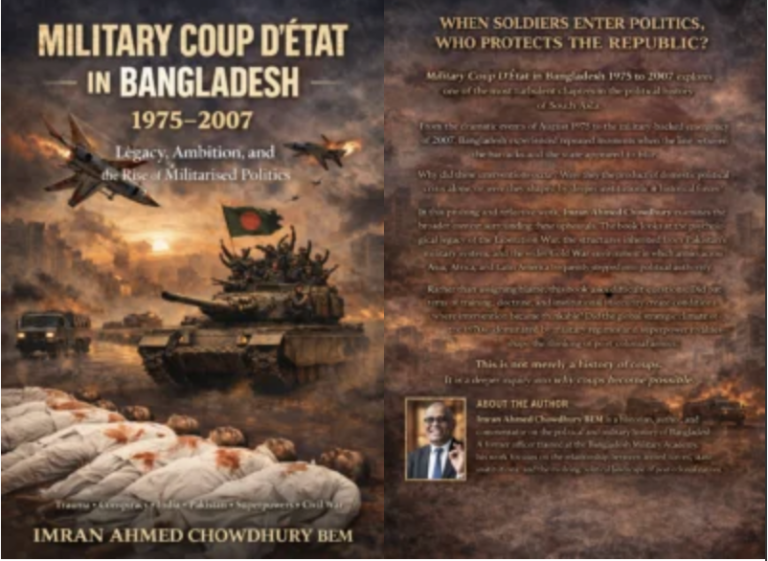
Military Coup d’État in Bangladesh
1975 to 2007
(Its Legacy Inherited from Pakistan?)
Between 1975 and 2007, Bangladesh experienced some of the most dramatic and unsettling moments in its political history. Assassinations, counter-coups, military uprisings, and emergency rule reshaped the nation’s fragile democratic institutions and left deep questions about the role of the armed forces in the life of the republic.
Why did these interventions occur?
Were they merely the product of domestic political crises, or were they shaped by deeper institutional and historical forces?
In Military Coup d’État in Bangladesh 1975 to 2007, Imran Ahmed Chowdhury offers a thoughtful and probing exploration of this turbulent era. Rather than assigning blame, the book examines the broader historical landscape: the legacy of military structures inherited from Pakistan, the psychological aftermath of the Liberation War, and the global Cold War environment in which military regimes appeared across continents.
The study also considers whether patterns of training, doctrine, and institutional culture created conditions in which the armed forces occasionally viewed themselves not only as defenders of the state, but as its ultimate guardians.
Spanning more than three decades of political upheaval, this book asks fundamental questions about power, legitimacy, and the fragile balance between civilian authority and military influence.
This is not merely a chronicle of coups.
It is an inquiry into why coups became conceivable in the first place.
The chapters are:
-
Bangladesh Liberation War and state formation
-
Genesis of Bangladesh Armed Forces
-
Pakistan Army legacy and repatriation
-
Civil-military relations in Bangladesh
-
1974 famine, governance, and crisis
-
Naxalite movements and internal insurgency
-
The coups of 1975 and aftermath
-
Zia, Ershad, and military-led politics
-
Cold War, SEATO, CENTO, US policy
-
India-Bangladesh-Pakistan triangular relations
-
Democracy, elections, and military influence
-
2007 caretaker intervention
About the Author
Imran Ahmed Chowdhury BEM is a historian, author, and commentator on South Asian political and military history. A former officer trained in the Bangladesh Military Academy, his writing combines historical analysis with a deep interest in the institutional evolution of armed forces in post-colonial states.
Chowdhury has written extensively on Bangladesh’s Liberation War, the legacy of military institutions, and the geopolitical forces shaping the country’s political trajectory. His work seeks to illuminate the complex relationship between history, power, and national identity.
Why I Felt Compelled to Write This Book
Some questions follow a person throughout life. They remain in the background of memory, quietly waiting for the moment when they must finally be confronted. For me, the story of military coups in Bangladesh was one such question—an unfinished chapter that lingered in whispers, fragments, and silences.
What struck me most during my service in the army as a young lieutenant in an infantry regiment was not simply the presence of military discipline or the routines of barracks life. It was the quiet, almost reluctant manner in which the past was remembered—or perhaps more accurately, how it was not remembered at all.
Within the regiment and across the wider military environment, the events of the coups were rarely discussed openly. No formal lectures explained them. No official narratives attempted to dissect their meaning. Yet their shadow lingered everywhere.
They existed in whispers.
Fragments of stories circulated quietly among officers and soldiers alike. Sometimes they were told cautiously over tea in the officers’ mess. Sometimes they surfaced late at night during conversations among younger officers trying to understand the institution’s history. At other times, the stories came from senior soldiers whose memories stretched back to periods of upheaval that we had only read about in textbooks.
But these stories were never complete.
They were always partial, uncertain, and wrapped in silence.
Names were mentioned in low voices. Certain officers were remembered as brave men who had stood for what they believed in. Others were spoken of with suspicion or contempt. Some were portrayed as heroes who had acted in the nation’s interest, while others were remembered as traitors whose ambitions had brought tragedy upon the country.
Yet what struck me most was not the conflicting interpretations—it was the silence.
No commissioned officer ever spoke openly about these events in any official setting. No institutional effort appeared to exist to explain what had happened during those turbulent years. Instead, the subject seemed to belong to a realm of quiet avoidance, as though discussing it openly might reopen wounds that had never properly healed.
Some officers had risen in their careers after those events. Others had disappeared from the institutional memory altogether. Some individuals were quietly remembered for having benefited from the changing tides of power, while others had paid the ultimate price—executed after court martial, imprisoned, or dismissed from service under circumstances that were never fully explained.
The contradictions were profound.
On one hand, the coups of Bangladesh formed a central chapter in the country’s modern history. On the other hand, within the very institution most closely connected to those events, they seemed to exist in a strange twilight between memory and silence.
For a young officer trying to understand the profession of arms, this absence of clarity was deeply perplexing.
How could such consequential events remain so poorly explained?
Why did the institution appear reluctant to confront its own past?
Why did stories circulate in whispers rather than in the open light of historical examination?
These questions lingered with me long after my time in uniform.
As the years passed, I began to realise that the story of the coups was not merely about political power struggles among officers or factions. It was also about the human cost of those events—the lives disrupted, the soldiers drawn into conflicts they did not fully understand, and the quiet tragedies that unfolded far from the public gaze.
Behind every coup attempt lies a chain of human experiences.
There were soldiers who followed orders without fully grasping the larger political context. There were junior officers who suddenly found themselves caught between loyalty to superiors and loyalty to the constitutional order. There were families whose lives were shattered when their loved ones were arrested, imprisoned, or executed.
There were also those who simply vanished from the narrative altogether.
Some individuals were court-martialled and sentenced under extraordinary circumstances. Others were imprisoned for years. Some faced the gallows. Their stories rarely appeared in official histories, and their personal experiences were seldom documented in any meaningful way.
And yet these men had once worn the same uniform as countless others.
They had marched in the same parades, trained on the same fields, and lived within the same institutional culture.
But when history moved forward, many of their names were quietly erased from the conversation.
This absence of historical accounting troubled me deeply.
A nation that experienced such dramatic upheavals should have produced a substantial body of scholarship examining those events. One might expect detailed historiographies analysing the political context, the institutional dynamics, and the human consequences of the coups.
Yet when I began searching for such work, I discovered something surprising.
The historiography was remarkably thin.
There were political commentaries, memoirs, and journalistic accounts. There were scattered academic analyses addressing specific episodes or personalities. But there was no comprehensive effort to examine the coups in their entirety—no sustained attempt to explore the deeper forces that made them possible.
More striking still was the absence of systematic documentation of the human cost.
The massacres.
The deaths.
The executions.
The imprisonments.
The court martials.
The quiet brutalities inflicted within the shadows of institutional power.
These events had left an indelible mark on the pages of Bangladesh’s history, yet the record remained fragmented.
Many of the individuals who lived through those events carried their memories privately. Some spoke cautiously in personal conversations. Others preferred silence, perhaps out of loyalty, perhaps out of fear, or perhaps simply out of exhaustion from reliving painful experiences.
But history cannot remain indefinitely buried beneath silence.
If these events were not examined critically, future generations would inherit only rumours and myths rather than understanding.
And that is precisely what troubled me most.
Within the military environment where I once served, stories of those turbulent years existed largely in the form of speculation. Some narratives portrayed certain individuals as martyrs. Others condemned them as conspirators. Without careful historical inquiry, it was impossible to separate legend from reality.
As someone who had once worn the uniform and observed the institution from within, I felt a growing sense of responsibility to explore this neglected chapter of history.
This book emerged from that sense of responsibility.
It is not written to pass judgment upon individuals. Nor does it seek to revive old grievances or reopen wounds that have long scarred the national consciousness. Rather, it attempts to ask difficult questions—questions that have remained largely unanswered.
Why did these coups occur in the first place?
What institutional, political, and psychological conditions allowed them to take shape?
Why did soldiers—many of them young and inexperienced—become instruments in struggles among competing elites?
What role did international dynamics play in shaping the political environment in which these events unfolded?
And perhaps most importantly, what were the human consequences of these upheavals?
The story of Bangladesh’s coups cannot be understood solely through the actions of generals or political leaders. It must also be examined through the experiences of the ordinary soldiers who found themselves caught in circumstances far beyond their control.
In many cases, these men were neither villains nor heroes.
They were simply individuals navigating a dangerous and uncertain moment in their country’s history.
Some followed orders.
Some resisted.
Some paid with their lives.
Others lived the remainder of their days carrying the invisible weight of events they could neither forget nor fully explain.
The silence surrounding these experiences is one of the reasons this book had to be written.
History demands more than rumours.
It demands careful examination, honest reflection, and a willingness to confront uncomfortable truths.
The coups of Bangladesh remain a defining feature of the country’s political evolution. They shaped institutions, altered political trajectories, and influenced the relationship between the barracks and the state for decades.
Yet they also left behind stories that have never been fully told.
Stories of ambition and fear.
Stories of loyalty and betrayal.
Stories of courage and tragedy.
Above all, stories of a nation struggling to define the boundaries between military power and democratic governance.
It was this complex tapestry of silence, memory, and unanswered questions that ultimately compelled me to undertake this work.
Writing this book has been both an intellectual challenge and a personal journey. It required revisiting events that remain sensitive in the national consciousness. It required examining narratives that are still contested and emotionally charged.
But it also offered an opportunity to illuminate a part of history that deserves careful study.
If this book contributes in some small way to a deeper understanding of those turbulent years, then the effort will have been worthwhile.
For history, however painful, must ultimately be confronted.
Not through whispers.
But through the honest pursuit of truth.