
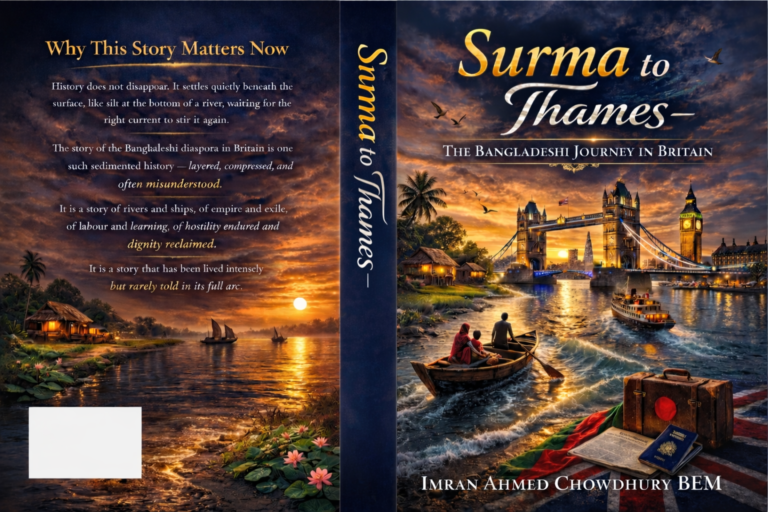
Surma to Thames: A History of Bengalis in Britain
From Surma to Thames:
Why This Story Had to Be Written
For many years, I felt that the story of the Bangladeshi journey in Britain was being told in fragments.
It appeared in community conversations, academic research, political speeches, and family memories. Yet something essential was missing — the continuity. The arc. The understanding that this journey did not begin at Heathrow, or at Brick Lane, or in a curry house kitchen.
It began in Bengal.
My book, Surma to Thames – The Bangladeshi Journey in Britain, is an attempt to tell that full arc.
Bangladesh is not simply a nation-state formed in 1971. It is a river civilisation. Formed by the vast delta of the Ganges (Padma), Brahmaputra (Jamuna), and Meghna river systems, it is a land shaped by water, erosion, rebuilding, and adaptation. Hundreds of rivers run through it. Villages move. Floods reshape landscapes. Generations grow up understanding that permanence is fragile and resilience is essential.
That geography produces a certain psychology — adaptability, endurance, patience.
When Bengalis migrated to Britain — first as lascar seafarers in the eighteenth and nineteenth centuries, then as industrial labourers in the 1950s and 1960s, and later as family settlers after 1971—they carried with them this river-shaped resilience.
For those of us from Sylhet, the Surma River carries a particular symbolism. Flowing quietly through the heart of Sylhet, it has witnessed generations of departure and return. Boats once travelled its waters carrying goods, travellers, and dreams. In many ways, the Surma represents the beginning of a journey that eventually reached far beyond Bengal’s horizon.
The relationship between Bengal and Britain, however, did not begin with voluntary migration. It began with an empire.
After 1757 and the consolidation of East India Company rule, Bengal’s revenue became central to British imperial expansion. Historians have debated the scale and interpretation of this financial transfer, but few dispute that Bengal was foundational to Britain’s imperial rise in India. This historical entanglement created the maritime, administrative, and economic channels through which migration would later flow.
The twentieth century reshaped everything.
The partition in 1947 divided Bengal. East Bengal became East Pakistan. Political instability and economic uncertainty encouraged migration. Britain, rebuilding after World War II, required labour. Commonwealth citizenship facilitated entry.
In the 1950s and 1960s, Bengali men—many from Sylhet—arrived in Britain in modest but steady numbers. They worked in factories, steel plants, textile workshops, and increasingly in catering. Most left their families behind. They sent remittances home. They imagined a return.
History intervened.
The Liberation War of 1971 decisively altered migration patterns. Family reunification in the 1970s transformed bachelor enclaves into permanent communities. Women and children arrived. Schools adapted. Mosques expanded. Community organisations formed.
The sojourner became the settler.
Much has been written about the “curry house revolution”. Less has been said about what it required — long hours, family labour, razor-thin margins, and extraordinary endurance. Bengali entrepreneurs built a national catering network that became part of Britain’s urban fabric. From those businesses came capital. From the capital came property. From stability came educational aspiration.
The first generation endured.
The second study.
The third entered professions.
Today, British-Bangladeshis are present in Parliament, the NHS, academia, business, the media, and civil society. Integration did not mean erasure. Cultural continuity coexists with civic participation. Religious identity has not prevented democratic engagement.
Challenges remain — educational disparities, socio-economic concentration, and internal debates over identity and modernity. But the trajectory is unmistakable.
Brexit has reshaped Britain’s political landscape. Immigration discourse has intensified. National identity debates continue. For the Bangladeshi diaspora, however, this is not an existential crisis. It is a moment of strategic maturity.
The question is no longer whether the community belongs.
The question is how it leads.
This book is not a grievance narrative. Nor is it triumphalism. It is a layered chronicle — of empire and entanglement, of migration and settlement, of survival and strategy.
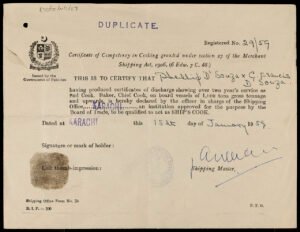
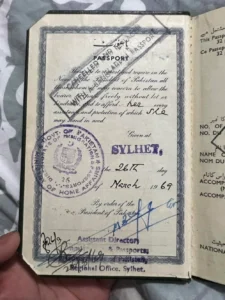
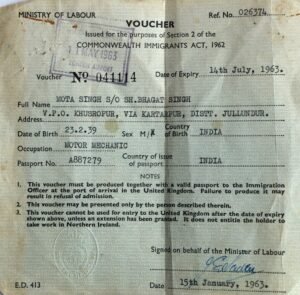
On a personal note, I witnessed the early stages of this migration as a young boy in Sylhet between 1968 and 1970. I saw village men queue for passports and tickets to “Bilat”. I watched the joy when a BOAC ticket was handed over. I heard the phrase, “If you have a Passcot, you can come to London.”
At the time, I did not understand immigration policy or global economics. I only understood hope.
Decades later, that memory remains vivid. It reminds me that diaspora is not abstract. It is lived. It is built one document, one sacrifice, one crossing at a time.
The Surma River flows quietly through Sylhet, but its story travels far.
Like all rivers, it does not end. It widens. It gathers tributaries. It carries memory forward.
From Surma to the Thames, the Bangladeshi journey in Britain is not a completed story. It is an unfolding one — rooted in resilience, shaped by history, and carried forward by generations who now move through Britain not as guests, but as citizens.
That is why this story had to be written.
Rivers Still Flow
History rarely announces its turning points. It gathers quietly, like sediment along the bend of a river. It settles, layer upon layer, until one day we recognise that beneath our present lies a vast accumulation of journeys, decisions, sacrifices, and endurance.
This book has traced one such accumulation.
From Bengal’s rivers to Britain’s capital.
From Surma’s shimmering currents to the steady tide of the Thames.
From tea chests and steamers to aircraft and urban skylines.
But at its core, this story is not about routes or infrastructure. It is about people.
And if there is one defining trait that runs through the history of the Sylhet region, it is resilience.
The Temperament of Water
Sylhet is a land shaped by rivers and haors — floodplains that transform with season. Monsoon swells can erase boundaries overnight. Water submerges fields, redefines paths, demands adaptation. Life in such terrain cultivates patience and vigilance. It instils a quiet understanding that stability must be earned repeatedly.
The people of this landscape grew accustomed to uncertainty long before they encountered migration.
They learned to rebuild after the flood.
To replant after loss.
To endure fluctuation.
This resilience did not originate in London or Birmingham. It was forged in villages bordered by water, in journeys by launch across moonlit rivers, in remote outposts reached by jeep and footpath.
When the first significant waves of migrants left Sylhet for Britain, they carried more than luggage. They carried this temperament.
The First Generations: Work Without Illusion
The early migrants did not arrive under illusion. Many came as temporary sojourners, expecting to earn and return. Their intention was not assimilation but responsibility. Responsibility to parents. To wives. To children who waited in distant villages.
Their early lives in Britain were defined by austerity.
Shared rooms.
Double shifts.
Cold mornings in unfamiliar climates.
Letters written home with carefully saved coins enclosed.
They worked in textile mills, warehouses, docks, garment factories, and foundries. They cleaned hotel rooms, washed dishes in restaurants, and carried crates in markets. Some entered catering and slowly, steadily, transformed Britain’s relationship with South Asian cuisine.
The now-iconic “curry house” began as a survival enterprise.
Dimly lit establishments at the margins of high streets. Men working through the night. Limited margins. Relentless schedules.
Yet what began in obscurity became an institution.
Through discipline and reinvestment, these small enterprises grew. They employed relatives. They trained apprentices. They created economic ecosystems within which thousands found livelihood.
It was not a dramatic success. It was incremental.
And it was earned.
Gratitude and Partnership
No migration story is complete without acknowledging the receiving society.
It would be neither accurate nor honourable to present the Bangladeshi journey in Britain as a solitary achievement. It was collaborative.
Thousands of British citizens — employers, teachers, neighbours, officials — extended opportunity.
Factory owners who hired men with limited English but strong hands.
Hotel managers who offered steady employment.
Warehouse supervisors who recognised reliability.
Small business proprietors who allowed newcomers to learn the trade and management.
Local authorities provided housing, schooling, and services. Immigration officers administered policies that — particularly after the 1962 and 1971 Acts — structured migration legally and gradually facilitated family reunification. Teachers supported second-generation children as they navigated bilingual identities.
These acts were often modest. Rarely headline-worthy. Yet collectively transformative.
Integration is not unilateral. It is reciprocal.
Britain, despite its complexities and imperfections, possessed the institutional capacity to absorb newcomers. The rule of law, civic structures, and economic opportunity created space for upward mobility.
The Bangladeshi community met that space with work.
The Shift from Sojourner to Citizen
A profound transformation occurred between the 1960s and 1980s.
The temporary labourer became a permanent resident.
The shared bachelor lodging became a family home.
The remittance earner became a property owner.
Family reunification altered community psychology. Children entered British schools. Women shaped domestic and social networks. Mosques, community centres, and cultural associations emerged.
The demographic growth was exponential. What began as a few thousand in the 1950s became tens of thousands by the 1970s, and over 100,000 by the late 1980s.
Yet numerical growth was only part of the story.
Educational attainment rose. Professional pathways expanded. The sons and daughters of factory workers became solicitors, doctors, academics, councillors, and entrepreneurs. The community moved from economic margin to civic participation.
Sylhet’s tenacity translated into intergenerational progress.
Identity Across Generations
The first generation measured success in stability. The second negotiated identity. The third and fourth speak with confidence.
Each generation faced different challenges:
The first endured economic hardship.
The second navigated cultural negotiation.
The third engages public discourse with fluency.
Intermarriage, professional diversification, and civic engagement reflect maturation.
Yet heritage remains.
Language, food, memory, and faith persist — though adapted to context.
Identity, like river water, changes shape while maintaining continuity.
The Quiet Devotion to Prosper
It would be simplistic to describe the community’s aspiration as mere economic ambition. It was devotion to dignity.
Prosperity was pursued not as indulgence but as protection.
To protect the family from insecurity.
To protect children from vulnerability.
To protect elders from dependence.
Savings were disciplined. Property investments were cautious. Education was emphasised.
This ethic did not emerge from ideology. It emerged from lived memory — of scarcity, of flood, of political upheaval, of war.
Resilience seeks stability.
The Author’s Journey
For me, this story is personal.
As a child growing up in Sylhet, I watched departures. School friends left mid-term to join their fathers in Britain. Stories of London circulated through tea stalls and village gatherings. The route to prosperity seemed to arc outward across oceans.
Even before Bangladesh’s independence, the instinct to write stirred quietly within me. Between the ages of eight and eleven, history fascinated me. The idea that lives and events formed patterns compelled me.
After independence, living across Sylhet’s towns and remote regions, I witnessed mass migration. The journeys by launch through Surma’s silver waters. The vast haors stretching beneath monsoon skies. The jeep journeys to border outposts. The layered realities of rural life intertwined with global aspiration.
Those memories never faded.
Years later, through research — books, archives, statistics, newspapers — the narrative deepened. Patterns became clearer. The connection between river commerce, colonial infrastructure, and diaspora emerged.
Nodi: to Thames is not a sudden undertaking. It is the fulfilment of a long-held aspiration.
Not Accusation, But Recognition
This book does not seek grievance.
It recognises extraction in history. It recognises hardship in migration. But it also recognises partnership and progress.
The Bengal-financed empire.
Britain provided an opportunity.
Sylhet provided resilience.
History is layered, not binary.
The Surma and Thames are connected not by sentiment but by centuries of exchange — commercial, political, cultural.
Rivers as Continuity
The Surma flows still.
The Meghna widens toward the sea.
The Thames curves past Westminster and Docklands.
Water ignores borders.
It reminds us that separation is often political, while continuity is geographic.
The journey from Nodi to Thames is ongoing.
New generations will redefine identity. They will debate integration and belonging. They will confront challenges — economic, cultural, geopolitical.
But they will do so anchored in history.
A Final Word of Thanks
To the pioneers who laboured without applause.
To the British citizens who extended the opportunity.
To the educators who nurtured bilingual brilliance.
To the employers who entrusted the responsibility.
To the institutions that upheld law and fairness.
This story belongs to you as well.
The river flows because many tributaries feed it.
The Closing Current
History accumulates quietly.
When tea chests floated down the Surma, few imagined their journey would foreshadow human migration. When steamers docked at Chandpur, few foresaw a community thriving along the Thames.
Yet continuity persisted.
River first.
Rail next.
Migration thereafter.
The Bangladeshi journey in Britain is not an anomaly. It is part of a longer arc of exchange between Bengal and Britain.
The river has not stopped.
And neither has the story.
From Nodi to Thames — the current continues.
Author’s Note
This book has been many years in the making.
It began not as a project, but as a question. How did a riverine district in eastern Bengal become so deeply connected with Britain? How did Sylhet’s villages — defined by paddy fields, haors, and winding waterways — produce a diaspora that reshaped urban Britain?
From childhood curiosity to adult research, the impulse to document this journey remained constant. Over decades, I read widely — history texts, economic analyses, demographic studies, memoirs, parliamentary debates, and archival material. I listened to stories. I revisited places in memory and in person.
This work does not claim final authority. It seeks clarity. It aims to present a layered narrative — acknowledging empire and extraction, hardship and opportunity, struggle and cooperation.
If this book contributes to a more nuanced understanding of the Bangladeshi presence in Britain — rooted in history yet oriented toward the future — then its purpose is fulfilled.
Rivers shaped us.
Migration transformed us.
History binds us.
The story continues…………