

Civil–Military Relations, Party Power and the Struggle for Constitutional Rule
Introduction
The Bangladesh Army occupies a central and complex place in the political history of Bangladesh. It emerged from the Liberation War of 1971 with immense public respect, identified with national sovereignty, sacrifice and the defence of the new state. Yet, in the decades after independence, military officers and military-backed authorities repeatedly intervened in politics, removed civilian governments, imposed martial law, reshaped constitutional arrangements and influenced political transitions.
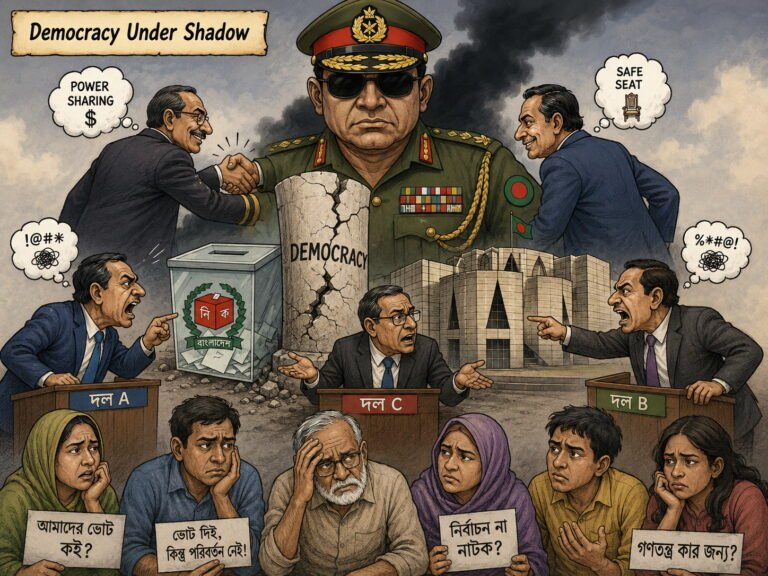
It is therefore fair to argue that the Army has been a major contributor to the weakening of democratic institutions in Bangladesh. However, it would be historically incomplete to claim that democracy was destroyed by the Army alone. Bangladesh’s democratic decline has resulted from a wider political failure: military intervention, civilian authoritarianism, bitter party rivalry, personalised leadership, patronage politics, weak parliamentary culture and the repeated refusal of political elites to accept democratic limits on their power.
The Constitution is unequivocal in principle. Article 7 states that all powers in the Republic belong to the people and may be exercised only under the authority of the Constitution. This makes civilian constitutional supremacy the foundation of the state. (Bangladesh Laws) Yet Bangladesh’s history shows how often this principle has been weakened when elected institutions became ineffective, partisan or unable to resolve political conflict.
The central argument of this essay is that Bangladesh has suffered from both military praetorianism and civilian authoritarianism. Military intervention damaged constitutional politics, while civilian politicians repeatedly weakened democratic institutions in their own struggle to retain power. The result has been a recurring cycle in which political failure creates space for unelected authority, and unelected authority further weakens the democratic system.
The Origins of Military Political Influence
Bangladesh was born from a traumatic war of liberation. The new republic inherited devastated infrastructure, millions of displaced people, economic weakness, political instability and the difficult task of building a functioning state. The armed forces were not merely another state institution. They were closely connected with the national story of liberation and survival.
This gave the military an unusual moral standing in public life. Some officers came to see themselves not only as defenders of the nation but as guardians of the state. Such an outlook is dangerous in a constitutional democracy. A professional Army may advise elected leaders on national security, defend territorial integrity and assist civil authorities under lawful direction. But it cannot claim a separate political mandate above Parliament, the courts or the electorate.
The danger is especially acute when civilian politics becomes discredited. If political parties are seen as corrupt, violent, incompetent or permanently divided, some citizens may begin to view the military as a neutral force capable of restoring order. This public mood may explain why military intervention sometimes receives initial support. It does not, however, provide constitutional justification for soldiers to assume political power.
The Crisis of 1975 and the Collapse of Constitutional Continuity
The first years after independence were marked by severe economic hardship, political violence, administrative weakness and public anxiety. By 1975, the political system was already under strain. The Fourth Amendment concentrated power in the presidency, and the one-party BAKSAL arrangement restricted competitive political activity. Democratic erosion, therefore, did not begin only with the military. Civilian leaders had already weakened pluralism, opposition politics and institutional checks.
Nevertheless, the events of 15 August 1975 marked a decisive rupture. The assassination of Sheikh Mujibur Rahman and the subsequent coups and counter-coups moved the centre of political authority away from elections, Parliament and constitutional procedures. Control of the state increasingly depended on armed power, internal military alliances and the ability to command force.
Bangladesh then entered a prolonged period of military rule, lasting from 1975 to 1990, before the popular uprising of 1990 restored parliamentary democracy. (Cambridge University Press & Assessment) This period created one of the most damaging precedents in the country’s history: the belief that political crises could be resolved through military intervention rather than constitutional procedures.
Bangladesh’s higher courts later rejected attempts to legitimise martial-law rule retrospectively. The Fifth Amendment, which had validated measures taken under martial law between August 1975 and April 1979, was struck down; the Seventh Amendment, which had protected the martial-law regime of H. M. Ershad, was also declared unconstitutional. (The Daily Star) These judgments reaffirmed a vital constitutional principle: force cannot become lawful merely because later political authorities try to validate it.
Ziaur Rahman and the Conversion of Military Power into Political Authority
General Ziaur Rahman emerged from the post-1975 upheaval as the central political figure. His supporters credit him with restoring stability, encouraging economic activity and widening political participation after a highly restrictive period. His critics point to the military foundation of his authority and the political order that grew out of it.
The democratic issue was not simply whether Zia introduced elections or created a political party. The deeper issue was the direction of legitimacy. In a democracy, leaders are elected first and govern afterwards. Under military-backed rule, power is often obtained through force and subsequently converted into electoral or constitutional legitimacy.
Zia’s creation of the Bangladesh Nationalist Party in 1978 illustrates this process. The party was built after his rise through the military-political crisis, and it won the 1979 parliamentary election. (CMI – Chr. Michelsen Institute) This was a significant political development, but it also established a lasting model: military authority could be converted into civilian party authority through controlled political transition.
This blurred the boundary between barracks and ballot box. It created the impression that a military ruler could first seize power and then secure democratic approval afterwards. Such a sequence does not represent the normal functioning of constitutional democracy. It represents the civilianisation of authority that originated outside constitutional rule.
Ershad and the Normalisation of Managed Democracy
The 1982 coup by Lieutenant General H. M. Ershad deepened the political damage. Ershad removed an elected government, imposed martial law and later attempted to build legitimacy through elections, administrative reforms and the formation of the Jatiya Party.
The existence of elections did not make the system democratic in substance. Opposition parties faced restrictions, political leaders were detained, press freedom was constrained and state machinery was used to sustain the ruling order. Parliament, parties and elections existed, but real authority remained concentrated around a military-backed presidency.
This is best understood as a form of managed democracy: a system in which democratic institutions formally remain, but the political field is shaped and controlled by unelected power. The 1990 mass uprising against Ershad was therefore not only a protest against one ruler. It was a rejection of the belief that military authority could permanently govern through a civilian façade.
The restoration of parliamentary democracy in 1991 was a major national achievement. Yet the underlying weaknesses of the political system were not resolved.
Post-1991 Democracy: Elections Without Democratic Consolidation
After 1991, Bangladesh returned to a parliamentary system and regular electoral competition. The Awami League and Bangladesh Nationalist Party became the dominant forces in national politics. (CMI – Chr. Michelsen Institute) The expectation was that democracy would gradually consolidate through elections, stronger institutions and peaceful transfers of power.
Instead, party competition often became intensely personal and confrontational. Parliament was boycotted, street protests became frequent, hartals and blockades were used as political weapons, and each major party treated the other less as a legitimate opponent than as an existential threat.
The problem was not only ideological disagreement. It was the fear of losing power. In Bangladesh, losing office could mean losing access to influence, patronage, state resources, protection and political relevance. Winning office could mean gaining control over public appointments, local administration, policing, business opportunities and electoral structures.
This turned democracy into a winner-takes-all struggle. The state was too often regarded as the prize of victory rather than as the shared property of the nation.
The Military-Backed Caretaker Government of 2007–08
The political crisis of 2006–07 once again exposed the vulnerability of Bangladesh’s democratic order. Disputes over electoral arrangements, the caretaker government and voter registration produced confrontation, violence and deep public distrust.
In January 2007, a military-backed caretaker government assumed power under a state of emergency. It promised order, anti-corruption measures, electoral reform and a credible election. Many citizens initially welcomed the intervention because they were exhausted by political conflict and feared wider violence.
The caretaker government did introduce some important reforms, including a new voter list with photographs and steps toward a more credible electoral process. However, it also operated under emergency powers, curtailed political activity, detained political leaders and raised serious human-rights concerns. Human Rights Watch reported that the military-backed caretaker government ruled through a state of emergency and documented arbitrary detention and abuses during this period. (Human Rights Watch)
This episode demonstrates an important contradiction. Political paralysis may explain why military involvement becomes publicly acceptable. It does not make such intervention inevitable or constitutionally necessary. The Army was not compelled to assume political authority. It chose to act when institutional weakness created an opportunity.
Civilian Elites, Military Influence and Reciprocal Advantage
It would be simplistic to argue that the Bangladesh Army acted alone in weakening democracy. In several historical phases, sections of the political elite, bureaucracy, judiciary and business establishment either accepted, facilitated or benefited from military influence.
Political paralysis, partisan violence, electoral mistrust and the refusal of major parties to respect democratic alternation created an environment in which military intervention could appear necessary, even desirable, to sections of society. Yet these crises did not make intervention constitutionally unavoidable.
The resulting relationship was often one of reciprocal advantage. Civilian actors could provide political, administrative or legal legitimacy. Military actors could provide coercive strength, administrative control and protection. This did not produce a stable democracy. It produced a cycle of managed elections, weakened institutions and recurring dependence on unelected authority.
This should not be described as a permanent conspiracy in which all actors always worked together. Often politicians and military officers were rivals. At other times, they used each other pragmatically. The more accurate description is a relationship of mutual dependence: political failure gave the military space to intervene, while military intervention weakened civilian institutions and made future political failures more likely.
The Conversion of Military Rule into Party Rule
A further and often overlooked problem in Bangladesh has been the conversion of military authority into civilian political authority. Some military rulers did not remain openly as a junta. Instead, they created political parties, held controlled elections, formed parliaments and sought civilian legitimacy after first acquiring power through military means.
This gave the appearance of democracy without always establishing its substance. The political system could contain elections, political slogans, party flags and parliamentary sessions, while decisive power rested in networks built around the former military ruler, the security establishment, administrative patronage and personal loyalty.
This process blurred the distinction between a professional Army, a military-backed regime and a civilian political party. Former military rulers who entered party politics needed to protect their political settlements, retain influence and prevent rivals from dismantling the structures that sustained them. Their organisations could therefore become highly centralised, leader-driven and dependent on loyalists rather than genuinely independent institutions.
Research on Bangladesh’s political settlement highlights the importance of limited access, patronage and elite bargaining in the distribution of political power. (ESID) Political authority has frequently been linked to access to resources, local influence, patronage networks and the ability to mobilise supporters against rivals.
This pattern was not confined to military-origin parties. Civilian parties also contributed to the problem. Major political formations often approached democracy not as a shared constitutional system in which opponents have a legitimate right to win elections and govern, but as a struggle for survival.
For this reason, Bangladesh has repeatedly displayed features of what scholars call competitive authoritarianism: a system in which elections and political parties formally exist, but fair competition, institutional independence and meaningful accountability are progressively weakened. (Cambridge University Press & Assessment)
It would be too sweeping to say that every politician, activist or party worker lacked sincerity. Many people entered political life with ideals, sacrifice and genuine commitment to public service. Yet the political incentives of the system too often rewarded control, loyalty and survival more than democratic restraint.
Across different periods, no major ruling formation consistently succeeded in creating a durable culture of institutional neutrality, internal party democracy, peaceful alternation of power and respect for an independent opposition. Bangladesh’s military and civilian elites alike too often treated the state as an entitlement to be captured, preserved and defended.
Civilian Authoritarianism and the Crisis Before 2024
The decline of democracy after 2009 cannot be explained only through military influence. Civilian authoritarianism became increasingly significant. The governing system relied on the growing concentration of executive power, reduced space for opposition politics, pressure on critics and the weakening of institutional independence.
The United Nations human-rights office found that Bangladesh’s former government, security forces and intelligence services were implicated in systematic repression during the July and August 2024 protests. (OHCHR) Freedom House similarly described the former Awami League government as having maintained power through the harassment of political opponents and the co-option of state institutions. (Freedom House)
This period is crucial because it demonstrates that democracy can be hollowed out without martial law. Authoritarianism does not always arrive through tanks, uniforms or coup announcements. It can also emerge through elected governments that weaken courts, suppress opponents, politicise administration, control electoral competition and turn security agencies into instruments of political power.
Thus, the Army’s historic interventions and civilian authoritarianism should not be seen as separate problems. They are connected. A political culture that accepts the capture of state institutions by one ruling group makes democracy fragile, regardless of whether those institutions are controlled by generals or politicians.
The 2024 Transition and the Return to Elected Rule in 2026
The student-led uprising of August 2024 brought down the Awami League government after widespread unrest and a violent crackdown. An interim government led by Muhammad Yunus took office with the backing of student protesters and the military. (Freedom House)
The Army did not establish a conventional military government. That restraint was important. Yet the military’s central role in the transition showed that it remained a decisive institution during moments of national crisis. A mature democracy should not depend on military judgement to determine political outcomes. Transitions should be governed by constitutional mechanisms, credible elections, parliamentary processes and the rule of law.
Bangladesh returned to elected rule through the parliamentary election of 12 February 2026. The Bangladesh Nationalist Party secured a decisive parliamentary majority, while a national referendum approved constitutional reform proposals. (Reuters) The Election Commission has published the official parliamentary election and referendum results. (ecs.gov.bd)
This return to electoral government creates an opportunity, but not a guarantee, for democratic renewal. The essential test is whether the new political order will establish credible checks and balances, protect opposition rights, strengthen judicial independence, preserve media freedom and ensure that the armed forces remain politically neutral.
Conclusion: Democracy Under the Shadow of Power
It is fair to say that the Bangladesh Army has been one of the most important historical forces behind the weakening of democracy. The coups of 1975, the military rule of Zia and Ershad, the martial-law periods and the military-backed caretaker government of 2007–08 damaged constitutional continuity and normalised the belief that military intervention could resolve political crisis.
However, it is not historically fair to say that the Army alone destroyed democracy. Civilian political leaders also weakened democratic institutions through intolerance, corruption, patronage, partisan use of administration, restrictions on opposition and the refusal to build a political culture of peaceful alternation.
The deeper tragedy is that military authoritarianism and civilian authoritarianism repeatedly fed each other. Military rule damaged constitutional politics. Civilian governments then used the state in increasingly partisan ways. Political crisis returned. The Army again appeared as a potential arbiter.
Bangladesh’s democratic struggle will remain incomplete until political power is understood not as an entitlement to be retained at all costs, but as a temporary public trust granted by citizens and limited by law.
The central lesson is clear: no institution—Army, political party, Parliament, judiciary, bureaucracy, intelligence agency or business elite—can be above the Constitution. Democracy can survive only when the armed forces remain professional and politically neutral, political parties accept the possibility of defeat, and citizens are able to choose governments freely without fear, manipulation or coercion.
Selected Bibliography
Amundsen, Inge. Dynasty or Democracy? Party Politics in Bangladesh. Bergen: Chr. Michelsen Institute, 2013.
Hassan, Mirza. Political Settlement Dynamics in a Limited-Access Order: The Case of Bangladesh. ESID Working Paper No. 23. Manchester: Effective States and Inclusive Development Research Centre, 2013.
Human Rights Watch. World Report 2008: Bangladesh. New York: Human Rights Watch, 2008.
Jahan, Rounaq. Political Parties in Bangladesh. CPD-CMI Working Paper No. 8. Dhaka and Bergen: Centre for Policy Dialogue and Chr. Michelsen Institute, 2014.
Jahan, Rounaq, and Inge Amundsen. The Parliament of Bangladesh: Representation and Accountability. Dhaka and Bergen: Centre for Policy Dialogue and Chr. Michelsen Institute, 2012.
Mostofa, Shafi Md., and D. B. Subedi. “Rise of Competitive Authoritarianism in Bangladesh.” Politics and Religion 14, no. 3 (2021): 431–459.
Office of the United Nations High Commissioner for Human Rights. Human Rights Violations and Abuses Related to the Protests of July and August 2024 in Bangladesh. Geneva: OHCHR, 2025.
Riaz, Ali. Bangladesh: A Political History Since Independence. London: I.B. Tauris, 2016.
van Schendel, Willem. A History of Bangladesh. Cambridge: Cambridge University Press, 2020.
Wolf, Siegfried O. “Civil-Military Relations and Democracy in Bangladesh.” Spotlight South Asia, October 2013.