
Bangladesh after the Change of Guard: Democratic Renewal, Institutional Fragility and the Risk of a Compound National Crisis
Abstract
Bangladesh entered a new political phase following the overthrow of Sheikh Hasina’s government in August 2024, the formation of the interim administration led by Muhammad Yunus and the parliamentary election of February 2026. The subsequent inauguration of Prime Minister Tarique Rahman’s government restored elected civilian rule but did not remove the structural economic, administrative and social problems accumulated over preceding decades. This essay argues that Bangladesh’s principal danger lies not in any single crisis but in the interaction of unemployment, inflation, uncertain economic growth, weakened law enforcement, urban infrastructural failure, political over-mobilisation, religious radicalisation and digitally accelerated misinformation. These pressures are generating what may be described as compound fragility: a condition in which individually manageable problems reinforce one another and reduce the capacity of the state to respond effectively. Bangladesh is not necessarily approaching state collapse; however, unless electoral legitimacy is translated into administrative competence, impartial law enforcement, employment-rich growth and institutional restraint, public expectations may turn rapidly into disillusionment. The country’s democratic transition therefore represents both an opportunity for renewal and a narrowing margin for political and policy error.
Keywords: Bangladesh, democratic transition, unemployment, governance, political instability, waterlogging, extremism, social media, foreign policy, institutional capacity
Introduction
Bangladesh’s most recent change of government represents one of the most significant political transitions in its post-independence history. The student-led uprising of 2024 ended Sheikh Hasina’s long period of government and was followed by an interim administration headed by Professor Muhammad Yunus. Parliamentary elections were subsequently held on 12 February 2026, and Tarique Rahman was sworn in as prime minister on 17 February after the Bangladesh Nationalist Party secured a commanding parliamentary majority. Commonwealth observers characterised the election as peaceful, orderly and transparent, while also acknowledging continuing concerns about political inclusion, institutional independence and the exclusion of the Awami League from participation. The transition therefore restored electoral government but did not fully resolve the deeper question of political legitimacy.
The new administration has inherited a country in which democratic expectations are exceptionally high but institutional capacity remains constrained. Bangladeshis expect employment, lower prices, public safety, functioning drainage, safer roads, administrative accountability and protection from political intimidation. Yet elections cannot automatically repair weakened institutions, change bureaucratic cultures or reverse years of economic distortion.
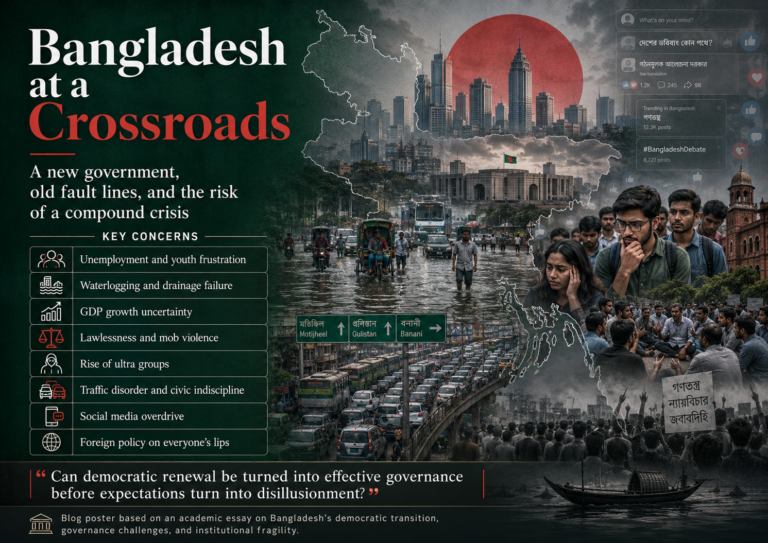
This essay argues that Bangladesh’s present vulnerability arises from the convergence of political, economic, infrastructural and social pressures. Unemployment alone may be manageable. Waterlogging alone may be manageable. Political polarisation, mob violence, religious radicalisation, traffic disorder and social-media misinformation may each be addressed individually. The greater danger emerges when they begin to reinforce one another.
Bangladesh may therefore be approaching not an inevitable collapse but a systemic tipping point. Whether it moves towards democratic consolidation or renewed instability will depend on the capacity of the new government to convert electoral authority into credible and impartial governance.
Democratic Legitimacy and the Burden of Expectation
The February 2026 election created an important opportunity for democratic renewal. Commonwealth observers reported that voting, counting and results management were generally conducted professionally. The election also expanded postal participation among overseas voters and represented the largest democratic exercise conducted within the Commonwealth during 2026. Nevertheless, the election occurred within an unresolved political environment shaped by the banning of the Awami League, doubts regarding the independence of state institutions and lingering disputes over accountability for the violence of 2024.
This combination produces a government with a substantial electoral mandate but also a heavy burden. A parliamentary majority provides the constitutional authority to govern; it does not, by itself, establish the administrative capacity required to govern effectively.
The distinction between electoral legitimacy and performance legitimacy is central to understanding Bangladesh’s new journey. Electoral legitimacy originates from the ballot box. Performance legitimacy must be earned continuously through service delivery, law enforcement, economic management and respect for constitutional limitations.
The danger is that the public may expect the new administration to correct within months problems that developed over several decades. Such expectations may be unrealistic, but they remain politically consequential. A population that has undergone uprising, repression, interim rule and national elections may possess less patience than a population experiencing an ordinary transfer of power.
The new government must therefore avoid the traditional tendency to substitute announcements for implementation. Bangladesh has repeatedly witnessed ambitious manifestos, development proclamations and highly publicised projects that did not produce corresponding improvements in citizens’ daily lives. Political promises initially generate hope, but unfulfilled promises eventually become evidence of governmental weakness or dishonesty.
Consequently, the transition will be judged less by the number of policies announced than by whether citizens experience measurable improvements in prices, employment, security, transport and municipal services.
Unemployment and the Political Economy of Frustration
Youth unemployment and poor-quality employment constitute perhaps the most serious long-term threat to Bangladesh’s political stability. Official unemployment figures do not adequately capture underemployment, informal labour, discouraged workers, unpaid family employment and insecure self-employment. A person working irregularly for a few hours may be statistically classified as employed while remaining economically vulnerable.
Research published by the International Labour Organization in 2026 identified a weakening relationship between economic growth and employment in Bangladesh. The study found increasing agricultural employment, declining paid employment, falling real wages and continuing labour-market disadvantages affecting young people and women. Agriculture’s share of employment increased to approximately 44 per cent by 2024, while manufacturing employment remained at around 11.5 per cent. Fewer than two per cent of young workers were classified as formal paid employees—the category most closely associated with stable earnings, job security and career progression.
These findings challenge the assumption that GDP growth will automatically generate sufficient employment. Bangladesh previously experienced relatively high reported growth without a proportionate expansion of secure and productive jobs. The consequences of this disconnection are especially severe for educated young people.
University graduates are not simply seeking survival-level economic activity. They expect professional progression, social dignity, financial independence and an opportunity to apply their education. Where qualifications increase but appropriate employment does not, education can unintentionally produce a politically conscious but economically frustrated social group.
The 2024 uprising demonstrated how employment-related grievances can merge with broader demands concerning fairness, dignity, political representation and state accountability. It would therefore be a serious error to treat unemployment merely as an economic indicator. It is also a political, social and national-security concern.
Young people who believe that the labour market is controlled by patronage, family connections, political affiliation or corruption may lose confidence in gradual institutional progress. Some may seek migration; others may become receptive to revolutionary politics, radical religious narratives or aggressive nationalism. Political organisations capable of offering identity, certainty and belonging may become especially attractive where the economy cannot provide security or purpose.
Employment creation must consequently be placed at the centre of macroeconomic policy rather than treated as a secondary benefit of growth.
Economic Growth, Inflation and Declining Policy Space
Bangladesh’s macroeconomic outlook remains uncertain. In April 2026, the World Bank projected GDP growth of approximately 3.9 per cent for the 2025–26 fiscal year. It also reported inflation of 8.5 per cent, a rise in the national poverty rate from 18.7 per cent in 2022 to 21.4 per cent in 2025, weak private investment, financial-sector stress and a tax-to-GDP ratio below seven per cent.
These figures reveal the limited policy space available to the new government. High inflation reduces real household income, particularly among workers whose wages do not rise at the same rate as food, transport, rent and energy costs. Weak tax revenue restricts the government’s ability to finance public health, education, policing, drainage and welfare. Stressed banks cannot efficiently direct capital towards productive businesses, while poor loan governance may protect influential borrowers at the expense of depositors and smaller enterprises.
The government is also managing relations with the International Monetary Fund while attempting to balance reform conditions against domestic political and welfare priorities. In July 2026, Bangladesh announced an understanding with the IMF concerning a phased approach to economic reform. Although gradual implementation may reduce immediate social pressure, delayed or incomplete financial-sector reform could allow underlying vulnerabilities to deepen.
Economic uncertainty is further intensified by external shocks. Bangladesh remains dependent on garment exports, imported fuel, remittances and access to international markets. Conflict in the Middle East, higher energy prices, changing trade conditions or reduced global demand can rapidly affect inflation, foreign-exchange reserves, government subsidies and industrial production.
The danger is not that Bangladesh will cease growing altogether. Rather, the country may experience growth that is too weak, concentrated or employment-poor to satisfy its expanding and increasingly educated population. GDP expansion without secure employment, wage growth and improved public services may intensify rather than reduce political dissatisfaction.
Waterlogging, Drainage and the Visibility of State Failure
Waterlogging has become one of the most visible manifestations of limited state capacity in Bangladesh’s urban centres. Dhaka and Chattogram repeatedly experience extensive disruption following heavy rainfall. Roads become impassable, businesses close, schools are interrupted, vehicles are damaged and residents are exposed to contaminated water.
Bangladesh’s geography and climate naturally create substantial flood risk. However, urban waterlogging cannot be attributed solely to rainfall. Academic studies identify rapid and unregulated urbanisation, wetland destruction, canal encroachment, inadequate drainage capacity, waste accumulation and weak maintenance as important contributing factors.
The institutional organisation of urban governance compounds the difficulty. Responsibility for roads, drains, canals, waste disposal, water supply and land development is distributed among multiple agencies. This fragmentation allows administrative responsibility to be transferred from one institution to another. When flooding occurs, every agency may possess an explanation, but no single authority accepts complete responsibility.
Recent climatic events underline the seriousness of the broader problem. In July 2026, monsoon floods and landslides killed dozens of people and stranded more than one million residents across several districts. River flooding, landslides and urban waterlogging are distinct phenomena, but all demonstrate Bangladesh’s growing exposure to extreme weather and inadequate infrastructure.
Waterlogging is politically important because it is experienced directly. Citizens may not understand the technical details of banking reform or monetary policy, but they understand when the road outside their house becomes unusable after ordinary rainfall.
A government that discusses national transformation while failing to maintain drains and protect canals risks losing credibility. Large development projects cannot compensate for the absence of basic municipal functionality. The effectiveness of a state is often measured most accurately not through monumental infrastructure but through whether everyday systems work reliably.
Traffic Disorder, Road Safety and Civic Indiscipline
Bangladesh’s road and traffic conditions represent another intersection between weak governance, inadequate infrastructure and social behaviour. The Asian Transport Observatory has reported that pedestrians and cyclists account for approximately 34 per cent of road fatalities and that only a small proportion of Bangladeshi roads achieve adequate safety ratings for vulnerable road users. The broader economic cost of road deaths and serious injuries has been estimated at approximately five per cent of GDP.
Dhaka’s congestion also imposes substantial productivity losses. A World Bank project assessment estimated that approximately 3.2 million working hours were being lost each day because of worsening traffic congestion, in addition to billions of dollars in annual economic costs.
Traffic disorder cannot be solved through road construction alone. It reflects poor licensing practices, unsafe vehicles, inadequate driver training, politically protected transport interests, weak enforcement, unsuitable pedestrian infrastructure and widespread disregard for traffic regulations.
In this sense, road behaviour reflects the wider political culture. Individuals demand institutional discipline while frequently treating public rules as negotiable. Vehicles disregard lanes, pedestrians are forced into traffic, buses stop without warning and pavements are occupied by commercial or private interests.
The state must enforce rules impartially, but citizens must also recognise that civic freedom does not include freedom from all regulation. A democratic society depends upon voluntary compliance as well as coercive enforcement.
Lawlessness, Mob Violence and the Erosion of the State
The prevalence of mob violence presents a more immediate threat to state authority. According to monitoring reported by the Human Rights Support Society, 31 people were killed in 66 incidents of mob violence and lynching during May 2026. The same report documented political violence, attacks on journalists and restrictions affecting freedom of expression.
Human Rights Watch had previously warned that the interim administration struggled to maintain law and order and that political organisations, religious hardliners and other non-state groups increasingly participated in mob violence. Although some repressive practices associated with the previous government declined, arbitrary arrests and politically motivated legal action continued to create concerns regarding impartial justice.
Mob violence represents more than criminal behaviour. It signifies the temporary replacement of legal authority by collective emotion. When a person can be attacked or killed on the basis of an accusation of theft, religious offence or political disloyalty, the state has effectively disappeared from that location.
Public mistrust of police and courts often contributes to vigilantism. However, distrust does not justify private punishment. Once accusations become sufficient grounds for violence, political activists, minorities, women, secular writers and socially marginalised individuals become particularly vulnerable.
The government must rebuild law enforcement while avoiding a return to partisan policing, enforced disappearance, torture or indiscriminate arrests. This requires professional investigation, independent complaints procedures, witness protection, forensic capacity and judicial reform.
Most importantly, the governing party must demonstrate that its own supporters are not above the law. Selective enforcement would reproduce the very political culture that the democratic transition was expected to replace.
Hardline Groups and the Risk of Ideological Radicalisation
The increased public visibility of hardline religious and ultra-nationalist groups has created further anxiety. This issue requires conceptual precision. Religious conservatism is not equivalent to violent extremism, and democratic government must protect peaceful religious belief, organisation and participation.
The concern arises when religious or nationalist actors use intimidation, mob pressure, threats or violence to restrict cultural activity, women’s participation, minority rights or freedom of expression.
Research by the S. Rajaratnam School of International Studies identified a growth in hardline mobilisation during the political transition, including moral policing, threats against cultural events, the circulation of extremist material and online attempts to influence young people. The analysis connected these developments to weakened law-enforcement capacity, political instability and unresolved public distrust of counterterrorism institutions.
The danger does not necessarily lie in the immediate seizure of political power by an extremist organisation. It lies in the gradual normalisation of coercive ideas. If administrators, schools, cultural bodies and local authorities repeatedly retreat whenever threatened, hardline groups learn that intimidation is effective.
Over time, democratic space can contract without a formal declaration. Cultural organisations may practise self-censorship, minorities may withdraw from public life, women may face new informal restrictions and moderate religious voices may be displaced by more aggressive actors.
An effective response must combine lawful security measures with education, youth employment, community engagement and credible religious scholarship. Repression without due process may create new grievances, but inaction may allow violent or coercive movements to consolidate themselves.
Hyper-Politicisation and the Digital Public Sphere
Bangladesh has become an intensely politicised society. Political debate now occurs continuously across television, Facebook, YouTube, TikTok, messaging applications, university campuses, professional networks and family gatherings. Foreign policy, defence relations, India, China, Pakistan, the United States and the Middle East have become subjects of mass public commentary.
This expansion of political participation can strengthen democracy. Citizens should scrutinise international agreements, strategic relationships and the conduct of political leaders. Foreign policy should not remain the private property of a small bureaucratic or military elite.
However, political awareness is not identical to political knowledge. Social-media platforms frequently reward speed, certainty, emotional intensity and confrontation rather than expertise or evidential caution.
Monitoring before the 2026 election found that Bangladesh’s online political environment was highly polarised. Offline violence generated spikes in inflammatory online content, while online narratives increased the risk of further physical escalation. Narratives concerning foreign interference—particularly alleged Indian interference—became increasingly prominent and were used to delegitimise political opponents and institutions.
Freedom House similarly found that internet freedom improved following the 2024 uprising but remained constrained by website blocking, arrests, online intimidation, surveillance concerns and manipulation by politically aligned commentators.
Bangladesh therefore faces an emerging form of diplomatic populism, in which complex foreign-policy questions are reduced to slogans concerning friendship, betrayal, sovereignty or national honour. Political actors may fear compromise because any negotiation can be presented online as surrender.
Diplomacy requires democratic accountability, but it also requires confidentiality, professional expertise and strategic patience. Not every discussion can be conducted in public while negotiations remain active. The absence of secrecy is not automatically transparency; it may also indicate institutional indiscipline.
A state in which ministers, advisers, retired officials, activists and anonymous online accounts appear to articulate competing foreign policies may become unpredictable to international partners. Bangladesh requires regular official briefings, parliamentary scrutiny and publication of completed agreements, but it must also preserve the confidentiality necessary for serious negotiation.
The Possibility of a Compound Crisis
Bangladesh’s greatest danger lies in the interaction of these problems. Economic frustration can increase support for radical or anti-system movements. Inflation can make communities more vulnerable to political patronage. Weak policing can encourage mobs and extortion. Mob violence can frighten investors and minorities. Low investment can further reduce employment. Social media can transform a local incident into a national confrontation before accurate information becomes available.
This is the logic of compound fragility.
A tipping point may therefore be triggered by an event that would ordinarily remain manageable: a controversial arrest, a communal rumour, an industrial closure, an increase in fuel prices, a border incident or a politically connected killing. The event itself may be limited, but it could activate multiple existing grievances simultaneously.
Nevertheless, collapse is not inevitable. Bangladesh possesses substantial sources of resilience, including a dynamic population, entrepreneurial capacity, an internationally connected diaspora, a major export sector, experienced civil servants, professional security institutions, active civil society and a younger generation that has demonstrated its capacity for political mobilisation.
The central question is whether these resources can be institutionalised. Popular resilience cannot indefinitely compensate for governmental weakness. Citizens should not be expected repeatedly to absorb the costs of institutional failure.
Conclusion
Bangladesh’s latest change of guard has opened a genuine possibility of democratic and institutional renewal. The elected government possesses both a strong parliamentary mandate and an opportunity to rebuild public confidence. Yet it has also inherited unemployment, inflation, weak banking governance, deteriorating urban infrastructure, political violence, radicalisation and a volatile digital information environment.
The country is not necessarily standing at the edge of immediate collapse. However, its margin for error is narrowing. The danger lies not in one catastrophic weakness but in the possibility that numerous unresolved pressures may converge.
Avoiding such an outcome requires measurable government performance. Employment must become a principal objective of economic policy. Banking and revenue reform must restore fiscal capacity. Urban drainage and transport must be treated as tests of state competence. Law enforcement must be strengthened without returning to partisan repression. Religious freedom must be protected while coercive extremism is firmly resisted. Foreign policy must remain democratically accountable but institutionally disciplined.
Above all, the government must demonstrate that political transition means more than the replacement of one governing elite by another.
The durability of Bangladesh’s democratic journey will ultimately depend not upon the scale of its promises but upon whether the state becomes fairer, safer, more competent and more dependable in the ordinary lives of its citizens.
References
Asian Transport Observatory (2025), Bangladesh Road Safety Profile 2025.
Build Up (2026), Bangladesh Elections Monitoring: Social Media Listening Report, 1 November–31 December 2025.
Commonwealth Observer Group (2026), Bangladesh Parliamentary Elections and Referendum, 12 February 2026: Final Report.
Freedom House (2025), Bangladesh: Freedom on the Net 2025.
Human Rights Support Society (2026), Human Rights Monitoring Report for May 2026, reported by the Dhaka Tribune.
Human Rights Watch (2026), World Report 2026: Bangladesh.
Kapoor, R. (2026), Reviving and Reconnecting Economic Growth and Employment in Bangladesh, International Labour Organization Working Paper No. 162.
Reuters (2026), “Tarique Rahman Sworn in as Bangladesh’s Prime Minister after Landslide Election Victory”, 17 February.
Reuters (2026), “Floods in Bangladesh Kill 44 and Leave More Than a Million Stranded”, 11 July.
S. Rajaratnam School of International Studies (2025), Bangladesh’s Evolving Security Crisis: The Rise of Religious Extremism amid Political Transition.
Taufiq, H. A. (2021), Dhaka Water-logging: Causes, Effects and Remedial Policy Options.
World Bank (2022), Integrated Corridor Management Dhaka North Project: Project Information Document.
World Bank (2026), Bangladesh Development Update: Urgent Reforms Needed to Restore Macroeconomic Stability, Sustain Growth and Create Jobs.