

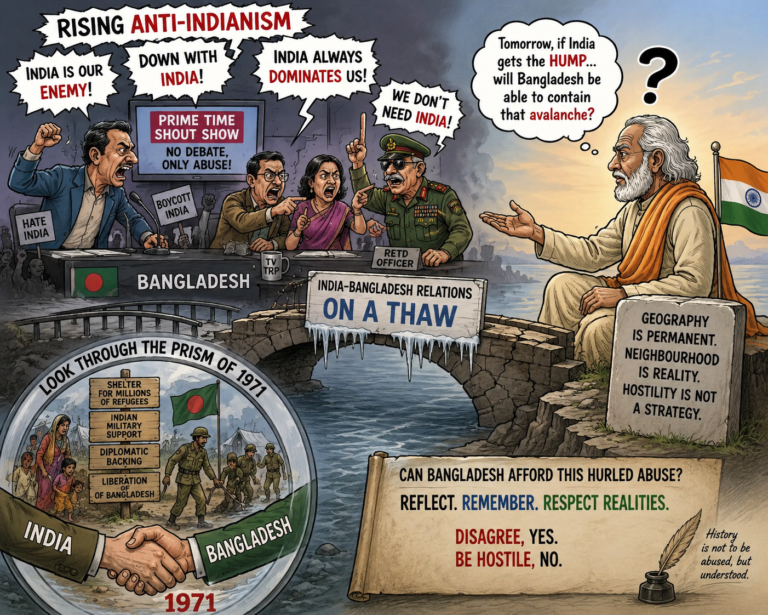
 In recent months, Bangladesh’s public discourse has witnessed a noticeable surge in anti-India rhetoric. What was once confined to fringe political circles has increasingly found its way into television talk shows, social media debates, and even comments from some retired military officers. The tone of these discussions has often become emotional, accusatory, and, at times, openly hostile.
One of the most worrying aspects is the deterioration of civil discourse. Television talk shows that should serve as platforms for informed debate are increasingly descending into theatrical confrontations where facts are frequently overshadowed by sensationalism. Rather than contributing to national policy discussions, some panels appear more interested in generating outrage and applause.
Equally striking is the apparent willingness of some commentators to overlook a fundamental historical reality. Bangladesh’s birth in 1971 was inseparable from India’s military, diplomatic, humanitarian, and logistical support. Millions of refugees found shelter across the border, while the Indian Armed Forces played a decisive role in the final defeat of the Pakistan Army in December 1971. As former Indian Prime Minister Indira Gandhi observed, “The struggle of Bangladesh is a struggle for humanity.”
This does not mean Bangladesh should abandon its right to disagree with India on water sharing, trade, border management, or regional security. Sovereign nations inevitably have disputes. However, disagreement is not the same as hostility.
The practical question is whether Bangladesh can afford a prolonged deterioration in relations with its largest neighbour. India remains a critical trading partner, transit route, energy supplier, and regional power. Geography is immutable. Nations may choose their friends, but they cannot choose their neighbours.
If political rhetoric continues to outpace strategic thinking, Bangladesh risks undermining its own interests. The country must ask itself a simple question: Does emotional nationalism serve its future better than pragmatic diplomacy?
Perhaps the answer lies in looking through the prism of 1971. History does not require permanent gratitude, but it does demand honesty. A mature nation should be capable of defending its interests while acknowledging the realities that shaped its birth and survival.
References
- Indira Gandhi’s speeches and statements during the Bangladesh Liberation War, 1971.
- Gary J. Bass, The Blood Telegram.
- Srinath Raghavan, 1971: A Global History of the Creation of Bangladesh.
- Chandrashekhar Dasgupta, India and the Bangladesh Liberation War.
- J.F.R. Jacob, Surrender at Dacca.