

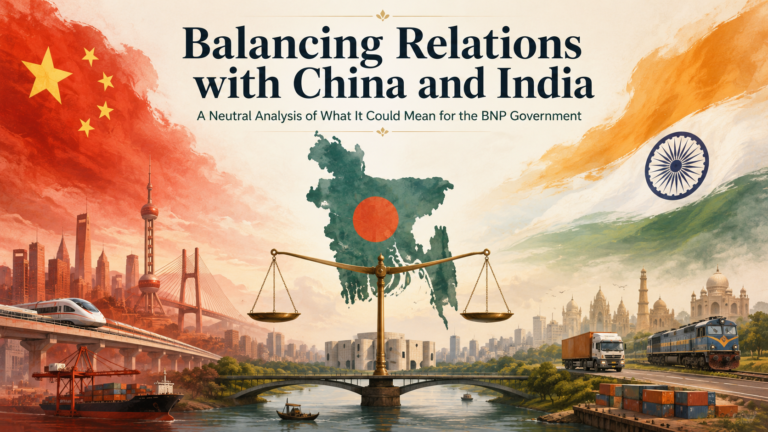
Balancing Relations with China and India: What Could It Mean for the BNP Government?
Bangladesh’s relations with China and India are becoming an increasingly important part of the country’s political and diplomatic discussion. China remains a major development, trade and defence partner, while India continues to be Bangladesh’s closest geographical neighbour and one of its most significant regional relationships.
Against this background, the Bangladesh Nationalist Party’s engagement with China, together with what some observers perceive as a more measured or reserved approach towards India, has attracted considerable attention.
The important question is whether this evolving foreign-policy direction could affect the BNP government’s political stability and its ability to remain in office.
A balanced assessment suggests that closer relations with China and a more independent approach towards India do not, by themselves, represent an immediate threat to the BNP government. Much will depend on how carefully Bangladesh manages both relationships and whether foreign-policy decisions produce practical benefits for the country.
A Policy of Strategic Balance
Bangladesh has traditionally attempted to maintain productive relations with several international partners rather than placing itself exclusively within one geopolitical camp.
From this perspective, stronger engagement with China does not necessarily mean that Bangladesh is moving away from India. It may instead reflect an effort to broaden the country’s diplomatic and economic options.
China can offer investment, infrastructure development, industrial cooperation, technology and defence equipment. India, meanwhile, remains essential because of geography, trade, energy, rivers, transport links, border management and regional security.
A successful Bangladeshi foreign policy will therefore require cooperation with both countries.
The BNP’s approach may be understood as an attempt to create greater strategic space for Bangladesh while preserving the country’s sovereignty and freedom of decision-making.
Why China Is Important to Bangladesh
China has become an important development partner for Bangladesh over several decades. Chinese companies and financial institutions have participated in infrastructure, energy, transport and industrial projects.
For any Bangladeshi government, cooperation with China can provide opportunities to improve roads, bridges, ports, power generation and manufacturing capacity.
The BNP government may also see China as a valuable source of investment and economic diversification. Stronger trade relations could potentially create employment, support industrial development and strengthen Bangladesh’s position in the regional economy.
At the same time, Bangladesh will need to examine Chinese-funded projects carefully. Large projects should be financially sustainable, transparent and capable of generating long-term economic benefits.
Bangladesh will also wish to reduce its trade imbalance with China by increasing exports and attracting investment that creates employment for Bangladeshi workers.
These are not arguments against cooperation with China. They are normal considerations for any country seeking to protect its economic interests while working with a major international partner.
India’s Continuing Importance
India will remain central to Bangladesh’s foreign policy regardless of which political party is in government.
The two countries share a long border, numerous rivers, historical connections and deep cultural and economic links. They also cooperate in areas such as electricity, trade, transportation, security and regional connectivity.
Differences between Bangladesh and India are natural and should not necessarily be viewed as signs of hostility. Neighbouring countries often have disagreements concerning water sharing, borders, trade arrangements, migration and political perceptions.
The challenge for both Dhaka and New Delhi is to manage such differences through dialogue, mutual respect and recognition of each other’s legitimate interests.
India also has strong reasons to maintain constructive relations with any democratically elected government in Bangladesh. A stable, prosperous and cooperative Bangladesh is beneficial to India’s northeastern region and to South Asia as a whole.
Similarly, Bangladesh benefits when its relationship with India remains predictable, respectful and based on equality.
Is the BNP Distancing Itself from India?
There may be a change in tone, but it would be premature to describe the BNP’s policy as a complete distancing from India.
The BNP has historically placed strong emphasis on Bangladeshi nationalism, sovereignty and an independent foreign policy. This may result in a diplomatic style that differs from that of previous governments.
Such differences do not necessarily mean that the BNP wishes to weaken relations with India. They may instead reflect a desire to redefine the relationship on what the party considers a more balanced and mutually respectful foundation.
Bangladesh and India will continue to need one another in practical areas. Trade, electricity, transport, border management and regional security cannot be managed effectively without regular cooperation.
The most constructive approach would therefore be for the BNP government to maintain open communication with New Delhi while also developing relations with China and other international partners.
The Sensitivity of Defence Cooperation
Defence cooperation is likely to be the most carefully observed aspect of Bangladesh’s relationship with China.
Bangladesh has the sovereign right to purchase defence equipment from different countries and to modernise its armed forces. China has long been an important supplier of military equipment to Bangladesh.
However, transparency and reassurance will remain important.
India may naturally be attentive to any military or security development involving China in its immediate neighbourhood. Bangladesh can help reduce misunderstanding by making clear that its defence partnerships are intended to strengthen its own national capacity and are not directed against any other country.
A useful guiding principle would be that Bangladeshi territory should not be used in a manner that threatens the legitimate security interests of its neighbours.
At the same time, neighbouring countries should recognise Bangladesh’s right to maintain an independent and diversified defence policy.
Mutual communication can prevent ordinary defence cooperation from being interpreted as a hostile strategic alignment.
Avoiding Unnecessary Political Rhetoric
Relations with India and China should ideally be discussed through the language of national interest rather than emotional political rhetoric.
Public concerns about water sharing, border incidents, trade imbalances or foreign influence should be addressed seriously. However, criticism of a particular policy should not become hostility towards a country or its people.
In the same way, closer relations with China should not be presented as a rejection of India, the West or any other partner.
A mature foreign policy allows Bangladesh to disagree with one country on a specific issue while continuing to cooperate in other areas.
Political parties also have a responsibility to ensure that foreign relations are not used to create unnecessary divisions within Bangladeshi society. National interest is best protected through calm diplomacy, institutional consultation and long-term planning.
Can China Replace India?
China and India play different roles in Bangladesh’s development and security environment. It may therefore be unhelpful to view the relationship as a choice between one country and the other.
China can contribute significantly through investment, infrastructure, technology and industrial development. India’s importance arises from immediate geography, shared rivers, border management, energy connections, trade routes and historical relationships.
Neither relationship is a complete substitute for the other.
Bangladesh’s interests are therefore best served by maintaining productive relations with both countries while also strengthening partnerships with the United States, United Kingdom, European Union, Japan, South Korea, Malaysia and other international actors.
Such diversification can reduce overdependence and give Bangladesh greater diplomatic flexibility.
Could Foreign Policy Affect BNP’s Stay in Power?
Foreign policy is unlikely to be the sole factor determining whether the BNP remains in government.
Bangladeshi citizens are more likely to judge the government on everyday matters such as prices, employment, public safety, healthcare, education, infrastructure and the quality of public administration.
Relations with China could strengthen the government if they result in productive investment, employment, improved infrastructure and increased exports.
Similarly, a stable relationship with India could support trade, energy security, border stability and regional connectivity.
Difficulties could arise only if relations with one country deteriorated significantly while cooperation with another failed to produce visible benefits.
For example, prolonged diplomatic tension could affect trade, energy supplies, transport or investment. However, such outcomes are not inevitable and can usually be avoided through careful engagement.
The BNP government’s political position will therefore depend less on choosing between China and India and more on whether it can manage both relationships competently while delivering effective domestic governance.
The Value of a Multi-Directional Foreign Policy
Bangladesh’s strongest position is likely to come from a multi-directional foreign policy.
China can be a partner in infrastructure, manufacturing, investment and technology.
India can remain a partner in trade, energy, rivers, border management, transport and regional connectivity.
Western countries will continue to be important for exports, investment, education, development cooperation and diplomatic engagement.
s economic development.
This approach would allow Bangladesh to maintain friendly relations with all major partners without becoming excessively dependent on any single country
It would also reflect Bangladesh’s longstanding principle of friendship and constructive cooperation in international affairs.
Conclusion
The BNP’s closer engagement with China and its more measured approach towards India should not automatically be regarded as a threat to its continuation in government.
It may represent a natural effort to diversify Bangladesh’s partnerships and maintain greater strategic independence.
However, the success of this policy will depend on balance, transparency and diplomatic restraint.
Bangladesh should remain friendly with China while maintaining constructive and respectful relations with India. It should also continue developing partnerships with Western countries, Japan and other Asian economies.
The central issue is not whether Bangladesh should choose China or India. The more important question is how Bangladesh can work confidently with both while protecting its sovereignty, economic interests and regional stability.
If the BNP government follows a balanced, inclusive and practical foreign policy, its relationships with China and India could become sources of national opportunity rather than political risk.